
Why Trapped-Ion Quantum Gates Depend on Shared Motion
Trapped-ion processors use collective vibrations to mediate interactions between qubits, making precise control of motion central to gate performance and scalability.
By The Quantum Lab desk
Written in-house by the The Quantum Lab desk — an explainer, not a report of a news event.
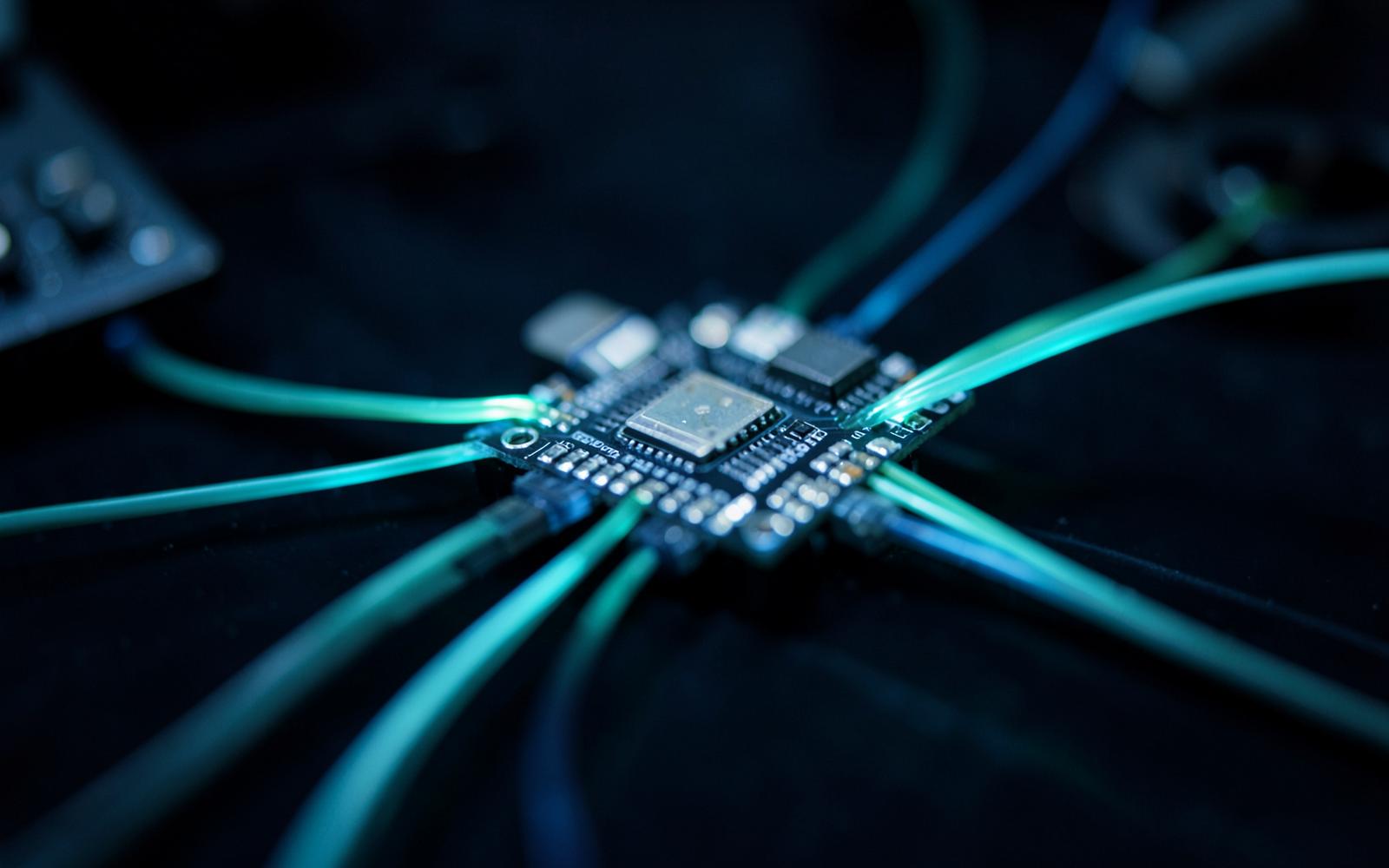
- Trapped-ion entangling gates commonly use collective vibrational modes as a temporary interaction bus.
- Cooling, calibration and pulse shaping help prevent residual motion from degrading gate fidelity.
- Larger ion chains create denser mode spectra, motivating modular architectures and segmented traps.
In a trapped-ion quantum processor, each qubit is encoded in selected internal energy levels of an ion confined by electromagnetic fields. Laser or microwave pulses can manipulate individual qubits, but the ions must also interact to perform entangling gates. A common approach uses the chain’s collective mechanical vibrations as a shared communication bus.
The Coulomb repulsion between ions couples their motion, so the chain vibrates in normal modes rather than as independent particles. Properly tuned control fields link an ion’s internal state to one or more of these modes, creating a state-dependent force. Applying such forces to multiple ions can accumulate an entangling phase between their qubits.
Ideally, the motional mode returns to its starting state when the gate ends, leaving only the intended qubit entanglement. If residual motion remains correlated with the qubits, tracing over that motion produces gate errors. Heating from electric-field noise, imperfect mode-frequency estimates and fluctuations in control fields can all prevent a clean return.
Experiments therefore cool relevant modes close to their quantum ground states and continually calibrate trap and control parameters. Pulse shaping can make gates less sensitive to small frequency offsets or unwanted coupling to nearby modes. Some gate designs can tolerate a limited amount of initial thermal motion, but uncontrolled heating and drift still reduce performance.
Scaling a single chain makes the motional spectrum more crowded and can complicate individual control, calibration and gate scheduling. Engineers address this with segmented traps that move ions between zones, smaller connected ion registers, or photonic links between separate modules. These approaches exchange the simplicity of one shared chain for additional transport, networking and control requirements.
This story started as a thread in our Discord. Join the discussion with the researchers and engineers who work on it.
Related
Surface-code processor stays below threshold as it scales to 1,000 qubits
The logical error rate keeps falling as the code distance grows — the clearest sign yet that adding qubits now buys reliability instead of noise.
Trapped-ion shuttling record pushes two-qubit fidelity past 99.9%
Moving ions between zones used to cost coherence. A revised trap geometry makes transport nearly free.

Open-source compiler cuts logical-qubit overhead by a third
A new lattice-surgery scheduler squeezes routing overhead out of fault-tolerant circuits, and it ships under a permissive license.