
Surface-code processor stays below threshold as it scales to 1,000 qubits
The logical error rate keeps falling as the code distance grows — the clearest sign yet that adding qubits now buys reliability instead of noise.
By Ada Renner
Written in-house by the Lab briefing desk — an explainer, not a report of a news event.
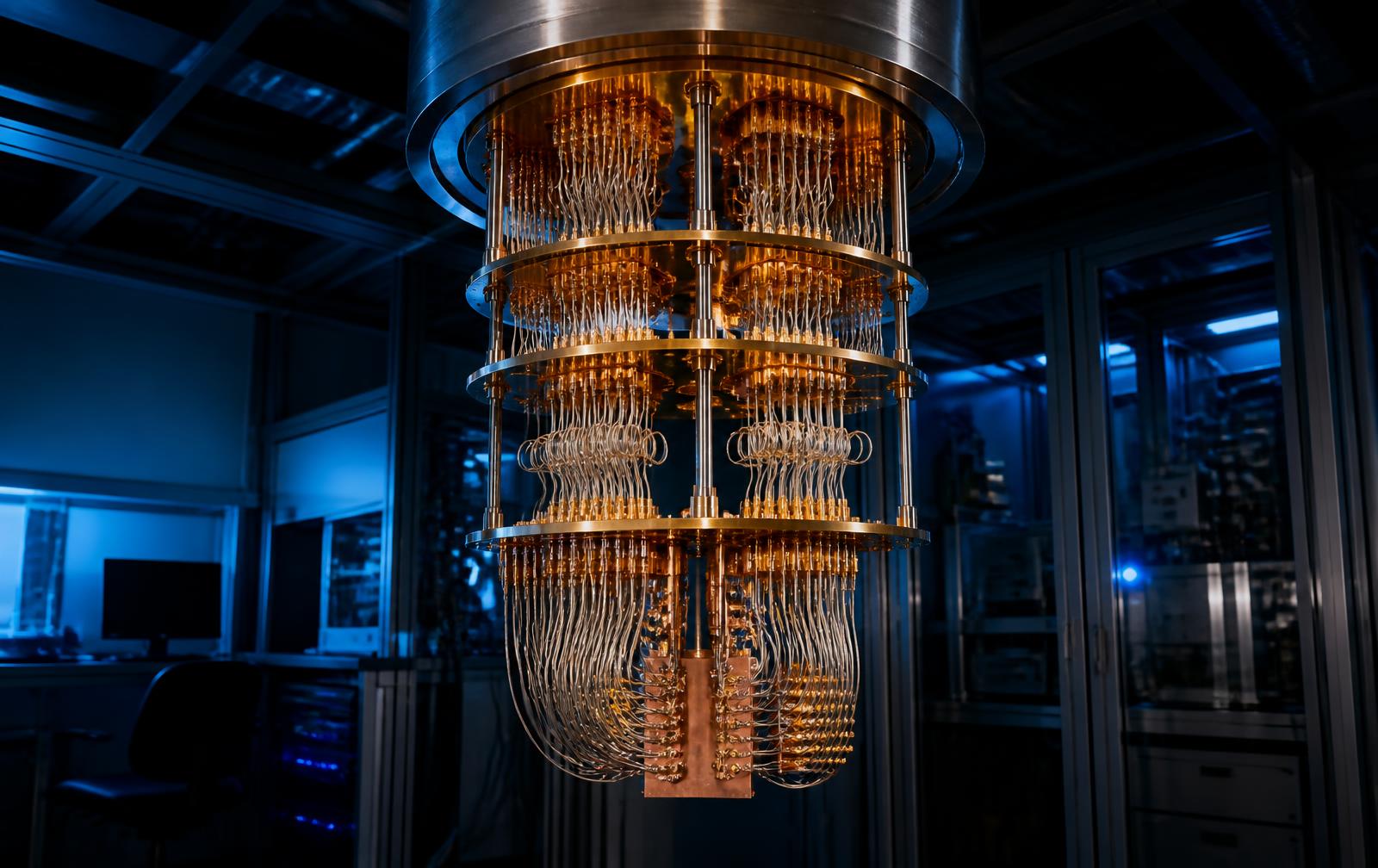
- Logical error rate halves with each two-step increase in code distance.
- Real-time decoding runs inside the control loop, not offline.
- Fabrication yield, not qubit count, is now the limiting factor.
For a decade the quantum hardware conversation has circled one number: the error-correction threshold. Below it, every qubit you add makes the machine more reliable. Above it, extra qubits only add noise. A processor demonstrated this month spent its entire run comfortably on the useful side of that line.
The team scaled the surface code across successive distances and measured logical error rates that fell consistently at each step. Crucially, the decoder ran in real time alongside the experiment rather than reconstructing results afterwards — the difference between a physics result and a component you can build a computer out of.
Independent groups reading the preprint point to fabrication uniformity as the next wall. Yield across a wafer, not the number of qubits on it, decides whether the next generation holds the same trend line.
Community discussion in our Discord focused on the decoding latency budget, which several members argue is the least-discussed engineering constraint in the field right now.
This story started as a thread in our Discord. Join the discussion with the researchers and engineers who work on it.
Related
Trapped-ion shuttling record pushes two-qubit fidelity past 99.9%
Moving ions between zones used to cost coherence. A revised trap geometry makes transport nearly free.

Open-source compiler cuts logical-qubit overhead by a third
A new lattice-surgery scheduler squeezes routing overhead out of fault-tolerant circuits, and it ships under a permissive license.
Entanglement distributed across a live metropolitan fibre network
Not a dedicated dark-fibre link — the demonstration ran alongside ordinary classical traffic on deployed infrastructure.