
Why Superconducting-Qubit Readout Balances Speed, Fidelity and Backaction
Dispersive readout infers a superconducting qubit’s state from its effect on a microwave resonator, avoiding direct energy measurement but introducing engineering tradeoffs among signal strength, measurement time and disturbance.
By The Quantum Lab desk
Written in-house by the The Quantum Lab desk — an explainer, not a report of a news event.
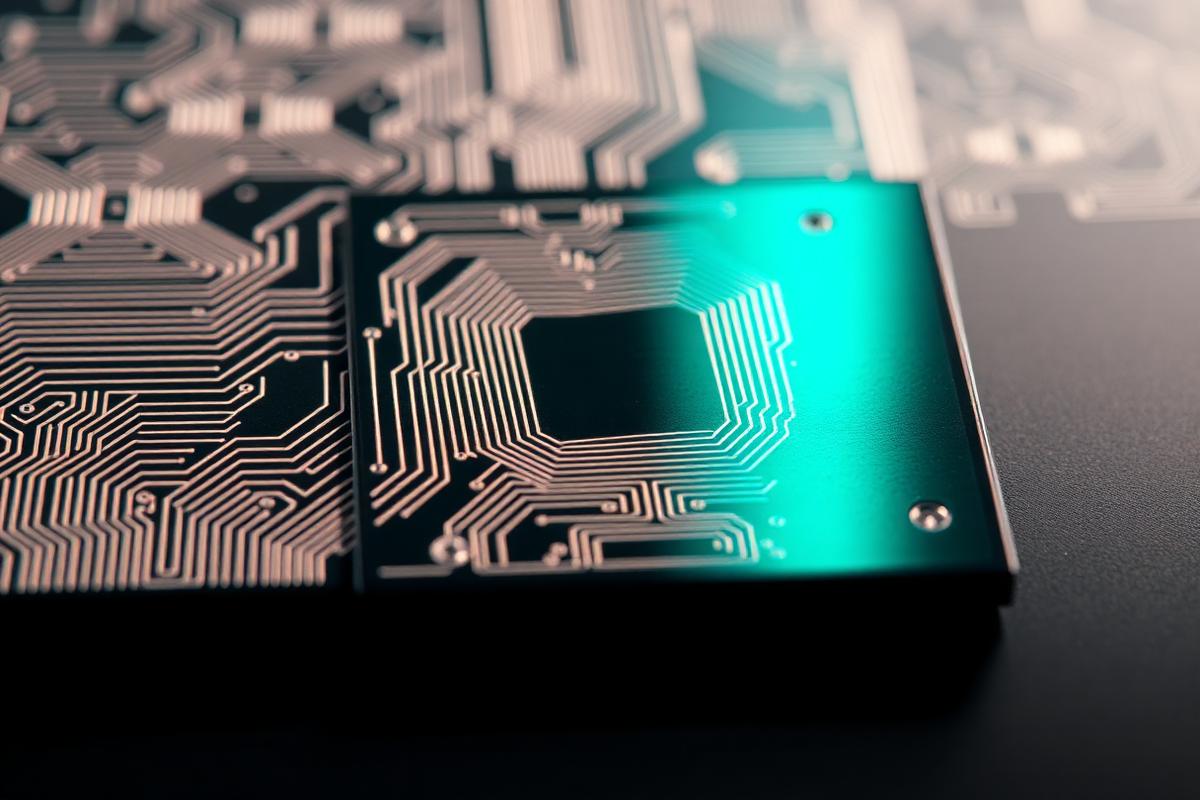
- Dispersive readout maps a qubit state onto a measurable shift in a resonator’s microwave response.
- Stronger and longer measurement pulses can improve state discrimination but also increase backaction and delay subsequent operations.
- Readout performance depends on the full measurement chain, including resonators, amplifiers, filters and statistical classification.
Most superconducting qubits are measured through a microwave resonator coupled to the qubit. In the dispersive regime, the qubit and resonator are sufficiently detuned that they do not normally exchange excitations, but the qubit state slightly shifts the resonator’s effective frequency. A microwave probe reflected from or transmitted through the resonator therefore acquires a state-dependent amplitude and phase.
The two possible responses are not perfectly distinct because the detected signal contains quantum fluctuations and added noise from the amplification chain. Engineers integrate the measured microwave field over time and classify the resulting signal as corresponding to the qubit’s ground or excited state. Longer integration usually improves separation, but it also makes measurement slower and leaves more time for the qubit to decay.
Increasing the number of probe photons can produce a stronger signal, yet this approach has limits. A powerful measurement pulse can push the qubit-resonator system beyond the approximation used for dispersive readout, cause unwanted state transitions or populate the resonator long enough to interfere with later gates. The useful operating point must therefore balance signal-to-noise ratio against measurement-induced backaction.
The resonator’s coupling to its output line creates another compromise. Strong coupling allows measurement photons to enter and leave quickly, but it can also provide a path for the qubit to lose energy through the resonator, an effect associated with Purcell decay. Filters and carefully designed coupling networks can suppress this decay while preserving rapid readout.
High-fidelity readout consequently depends on more than the qubit itself. Low-noise amplifiers, including quantum-limited parametric amplifiers, help preserve weak microwave signals, while pulse shaping and statistical classifiers reduce assignment errors. Engineers must evaluate the complete chain because qubit relaxation, thermal excitation, resonator dynamics and amplifier noise can all produce similar-looking mistakes in the final measurement record.
This story started as a thread in our Discord. Join the discussion with the researchers and engineers who work on it.
Related
Surface-code processor stays below threshold as it scales to 1,000 qubits
The logical error rate keeps falling as the code distance grows — the clearest sign yet that adding qubits now buys reliability instead of noise.
Trapped-ion shuttling record pushes two-qubit fidelity past 99.9%
Moving ions between zones used to cost coherence. A revised trap geometry makes transport nearly free.
Open-source compiler cuts logical-qubit overhead by a third
A new lattice-surgery scheduler squeezes routing overhead out of fault-tolerant circuits, and it ships under a permissive license.