Why Qubit Readout Is More Than a Final Measurement
Quantum processors must convert fragile quantum states into reliable classical data, making readout a central hardware and systems-engineering challenge.
By The Quantum Lab desk
Written in-house by the The Quantum Lab desk — an explainer, not a report of a news event.
- Qubit readout infers quantum states through a coupled measurement apparatus rather than observing them directly.
- Faster and stronger measurements can improve state discrimination while increasing disturbance, crosstalk and hardware demands.
- Reliable readout depends on calibration and statistical modeling as well as the underlying quantum device.
A quantum processor produces useful results only when qubit states can be translated into classical records. Because a single measurement returns one probabilistic outcome, an algorithm usually must be repeated many times to estimate the distribution of possible results. Readout errors can distort that distribution even when the preceding quantum operations work as intended.
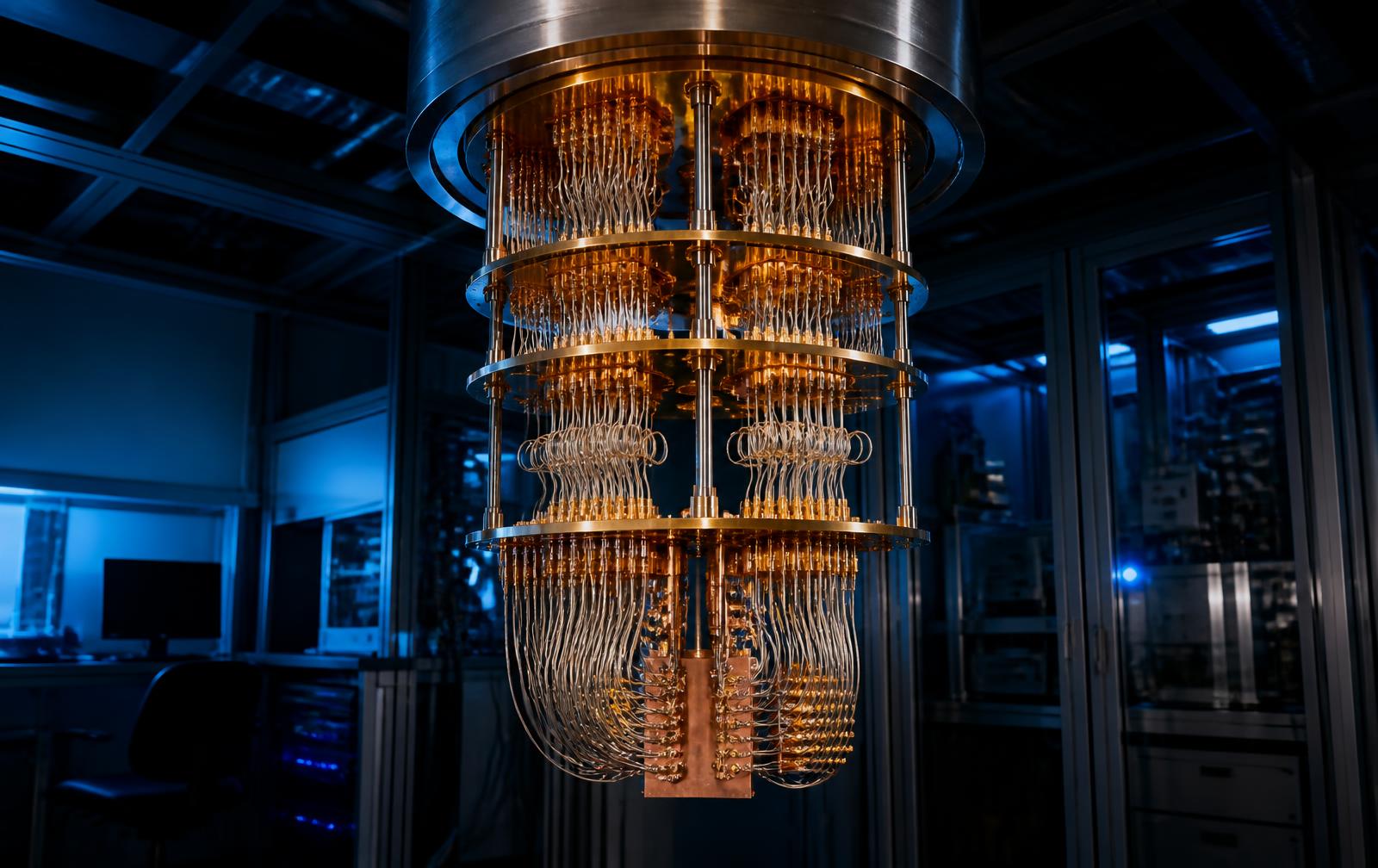
In many superconducting-qubit systems, each qubit is coupled to a microwave resonator whose response depends on the qubit state. A probe signal sent through or reflected from the resonator acquires a state-dependent change in amplitude or phase, which room-temperature electronics classify as a classical zero or one. This dispersive method avoids trying to detect the qubit's microscopic excitation directly.
Readout strength and duration involve engineering trade-offs. A longer or stronger probe can make the two states easier to distinguish, but it may also induce unwanted transitions, increase heating or disturb nearby qubits. An ideal quantum non-demolition measurement would preserve the measured observable, but practical devices only approximate that behavior.
Scaling adds another layer of difficulty because processors need many readout channels without an equal multiplication of cables and components. Frequency multiplexing allows several resonators to share a transmission line, but overlapping responses, amplifier limitations and microwave crosstalk can reduce accuracy. The readout chain must therefore be designed alongside qubit frequencies, packaging and control electronics.
Readout performance is commonly characterized by preparing known states and comparing them with the reported outcomes. Those calibration data can support corrections for state-assignment errors, although such corrections cannot recover information lost through poorly modeled drift or measurement-induced transitions. Readout is consequently not a single component but a chain linking device physics, analog electronics, signal processing and statistical inference.
This story started as a thread in our Discord. Join the discussion with the researchers and engineers who work on it.
Related
Surface-code processor stays below threshold as it scales to 1,000 qubits
The logical error rate keeps falling as the code distance grows — the clearest sign yet that adding qubits now buys reliability instead of noise.
Trapped-ion shuttling record pushes two-qubit fidelity past 99.9%
Moving ions between zones used to cost coherence. A revised trap geometry makes transport nearly free.
Open-source compiler cuts logical-qubit overhead by a third
A new lattice-surgery scheduler squeezes routing overhead out of fault-tolerant circuits, and it ships under a permissive license.