Why Quantum Processors Need Continuous Calibration
Qubit control depends on precisely tuned frequencies, pulse shapes and measurement thresholds, but those settings drift as devices and their environments change.
By The Quantum Lab desk
Written in-house by the The Quantum Lab desk — an explainer, not a report of a news event.
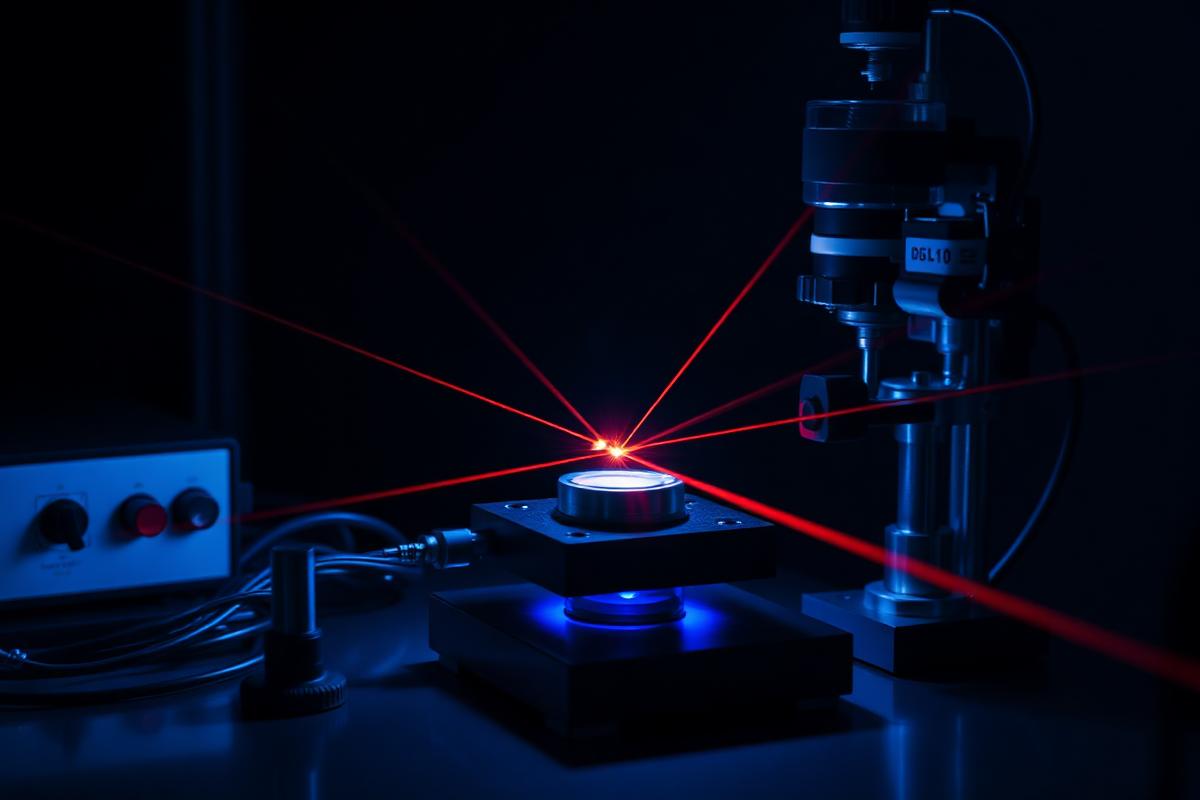
- Calibration translates desired quantum operations into hardware-specific control signals.
- Environmental fluctuations and device interactions can gradually invalidate calibrated settings.
- Automated monitoring and recalibration are essential as quantum processors grow larger.
Quantum programs are expressed as ideal gates, but hardware executes them using analog signals such as microwave pulses, laser fields or voltage waveforms. Calibration determines the amplitudes, frequencies, phases and durations needed to produce the intended operations on a particular device. It also establishes how measurement signals should be classified as qubit states.
These settings are not permanently stable. Temperature changes, fluctuating electromagnetic environments, charge motion in materials and variations in control electronics can shift qubit frequencies or alter how strongly a qubit responds to a pulse. In atomic systems, changes in laser intensity, frequency or beam alignment can produce similar effects.
Calibration parameters are also interdependent. Adjusting a pulse to improve one gate can change crosstalk, leakage into non-computational states or phase accumulation elsewhere in the processor. Multi-qubit gates are especially sensitive because they depend on accurately controlling interactions while limiting unwanted coupling to neighboring qubits.
Engineers track performance using experiments such as spectroscopy, Rabi oscillations, Ramsey measurements and randomized benchmarking. The resulting data can feed optimization routines that update control parameters, while shorter diagnostic checks can detect when a full recalibration is necessary. The objective is not to eliminate all drift, but to identify and correct it before it substantially degrades computation.
Scaling makes this task harder because the number of relevant parameters and interactions grows with the system. Recalibrating every component sequentially can consume significant operating time, while simultaneous calibration risks introducing interference between control channels. Practical quantum computing therefore requires calibration software that can manage dependencies, schedule measurements and respond to drift with limited human intervention.
This story started as a thread in our Discord. Join the discussion with the researchers and engineers who work on it.
Related
Surface-code processor stays below threshold as it scales to 1,000 qubits
The logical error rate keeps falling as the code distance grows — the clearest sign yet that adding qubits now buys reliability instead of noise.
Trapped-ion shuttling record pushes two-qubit fidelity past 99.9%
Moving ions between zones used to cost coherence. A revised trap geometry makes transport nearly free.
Open-source compiler cuts logical-qubit overhead by a third
A new lattice-surgery scheduler squeezes routing overhead out of fault-tolerant circuits, and it ships under a permissive license.