
Why Quantum Processors Need Careful Cryogenic Engineering
Many leading quantum processors operate near absolute zero, making refrigeration, wiring and heat management central engineering challenges rather than peripheral infrastructure.
By The Quantum Lab desk
Written in-house by the The Quantum Lab desk — an explainer, not a report of a news event.
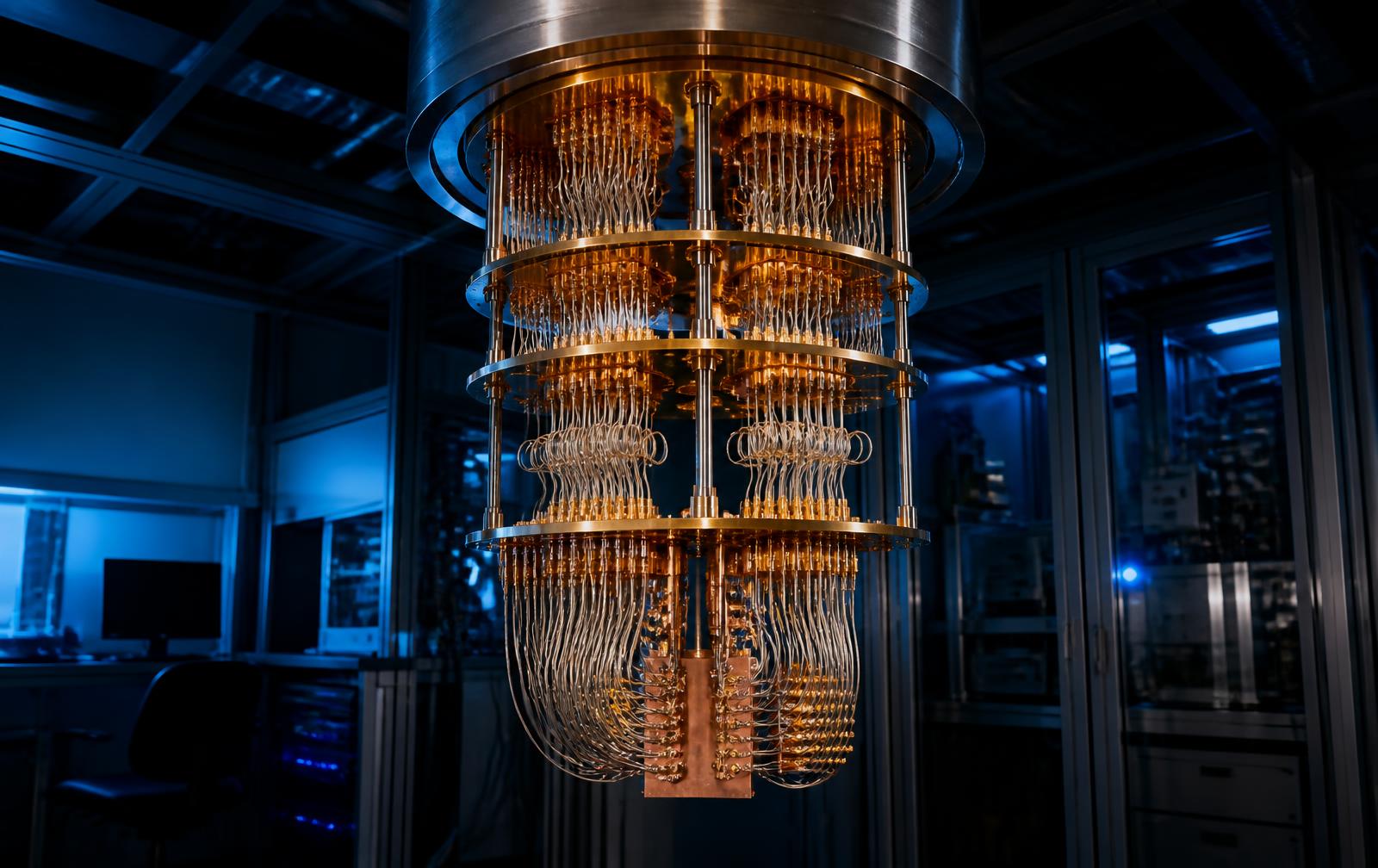
- Low temperatures suppress thermal noise and enable superconducting quantum circuits to operate coherently.
- Control wiring introduces heat and noise that must be filtered without excessively weakening or delaying signals.
- Scaling cryogenic quantum hardware requires the refrigerator, electronics, packaging and processor to be designed as one system.
Superconducting quantum processors are typically cooled to temperatures of only a few tens of millikelvin. At these temperatures, electrical resistance can vanish in superconducting materials, and thermal excitations are less likely to disturb the small energy differences used to encode and manipulate quantum states.
Reaching such temperatures generally requires a dilution refrigerator, which uses a circulating mixture of helium isotopes to remove heat in stages. The available cooling power decreases sharply toward the coldest stage, so even small heat loads from cables, amplifiers and mechanical supports can affect system performance.
A processor must still communicate with room-temperature control equipment. Microwave lines deliver control pulses to qubits, while separate signal paths carry weak measurement signals back to amplifiers; each line can also conduct heat and introduce electrical noise unless it is carefully attenuated, filtered and thermally anchored.
This creates a trade-off between signal quality and thermal isolation. Strong attenuation can protect qubits from room-temperature noise but also reduces control-signal power, while additional components and connectors can introduce loss, reflections or failure points.
Scaling is therefore not simply a matter of placing more qubits on a chip. Larger systems require denser wiring, more cooling capacity, compact packaging and control architectures that limit heat dissipation near the processor, making cryogenic engineering an integral part of quantum-computer design.
This story started as a thread in our Discord. Join the discussion with the researchers and engineers who work on it.
Related
Surface-code processor stays below threshold as it scales to 1,000 qubits
The logical error rate keeps falling as the code distance grows — the clearest sign yet that adding qubits now buys reliability instead of noise.
Trapped-ion shuttling record pushes two-qubit fidelity past 99.9%
Moving ions between zones used to cost coherence. A revised trap geometry makes transport nearly free.

Open-source compiler cuts logical-qubit overhead by a third
A new lattice-surgery scheduler squeezes routing overhead out of fault-tolerant circuits, and it ships under a permissive license.