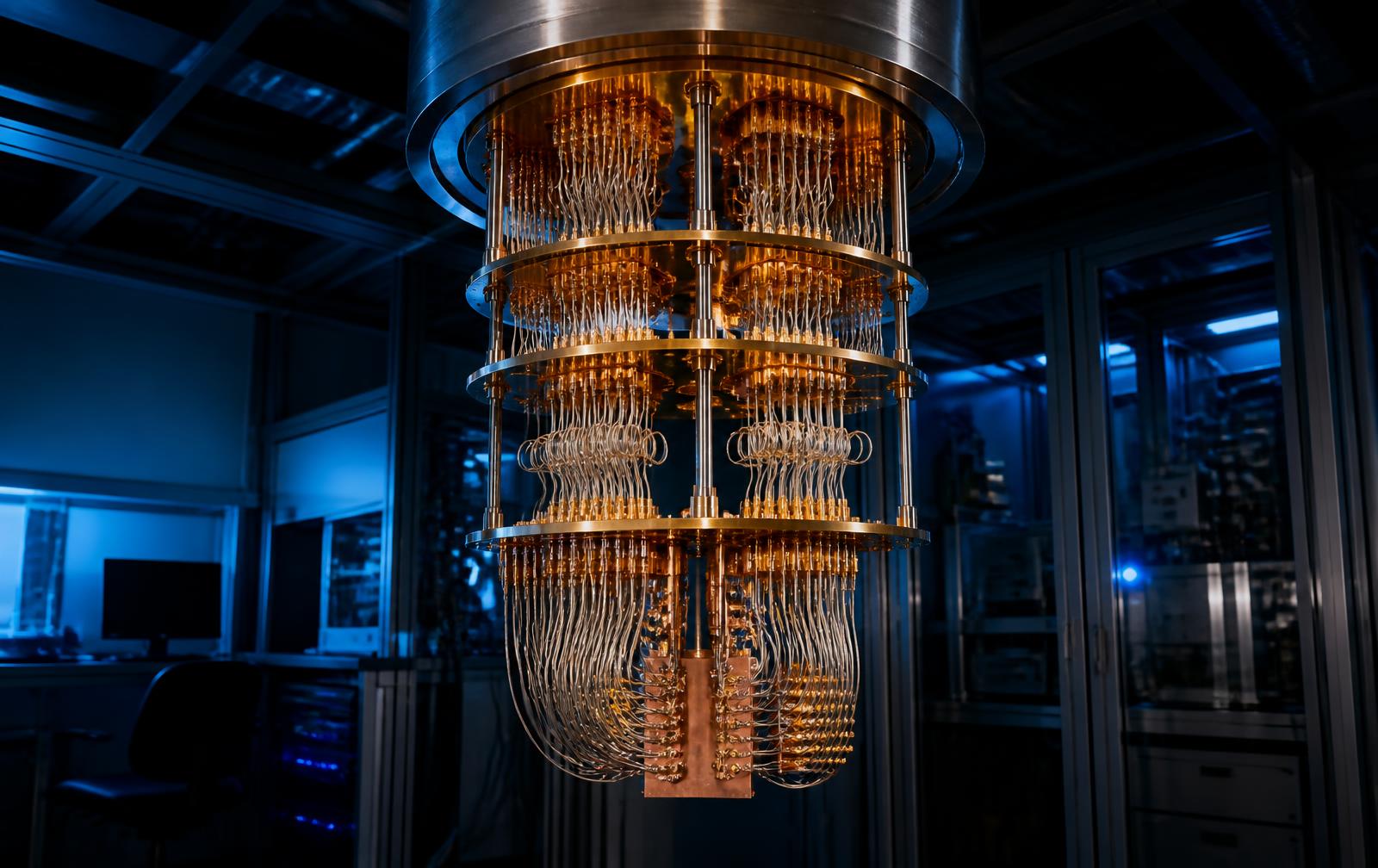
Why Quantum Phase Estimation Matters
Quantum phase estimation is a foundational algorithmic technique for extracting eigenvalue information from quantum systems, but its practical value depends on demanding state preparation, controlled operations and measurement precision.
By The Quantum Lab desk
Written in-house by the The Quantum Lab desk — an explainer, not a report of a news event.
- Phase estimation converts an eigenphase encoded in a quantum operation into a classical numerical estimate.
- Its precision is determined by coherent circuit depth, available ancilla qubits and the number of measurements.
- Practical applications must account for the cost of preparing suitable input states and implementing controlled time evolution.
Quantum phase estimation addresses a specific task: estimating the phase associated with an eigenvalue of a unitary operation. If a state |ψ⟩ satisfies U|ψ⟩ = e^(2πiφ)|ψ⟩, the algorithm seeks a binary approximation to φ, which can in turn reveal quantities such as molecular energies or periods in arithmetic problems.
In the standard circuit, ancilla qubits control repeated applications of increasing powers of U. An inverse quantum Fourier transform then converts the accumulated relative phases into a bit string that can be measured, with additional ancillas providing finer precision when operations are sufficiently accurate.
This compact description hides substantial engineering costs. Implementing controlled powers of U may require long coherent circuits, while preparing an input state with significant overlap with the desired eigenstate can be difficult; if the overlap is small, measurements will rarely return the target eigenphase.
Several variants trade circuit depth, qubit count and sampling effort. Iterative and Bayesian approaches can use fewer ancillas and replace a large inverse Fourier transform with repeated measurements and classical updates, but they still require controlled evolution and enough experimental repetitions to resolve the phase.
Phase estimation is central to many theoretical quantum algorithms because eigenvalues encode useful physical and mathematical information. Whether it provides a practical advantage on a given machine depends on the full resource accounting, including state preparation, simulation accuracy, fault-tolerant gate synthesis and the precision actually required by the application.
This story started as a thread in our Discord. Join the discussion with the researchers and engineers who work on it.
Related
Open-source compiler cuts logical-qubit overhead by a third
A new lattice-surgery scheduler squeezes routing overhead out of fault-tolerant circuits, and it ships under a permissive license.
A shared benchmark suite for logical qubits gets a first draft
Vendors publish incomparable numbers. A working group wants one protocol everyone can run.
Surface-code processor stays below threshold as it scales to 1,000 qubits
The logical error rate keeps falling as the code distance grows — the clearest sign yet that adding qubits now buys reliability instead of noise.