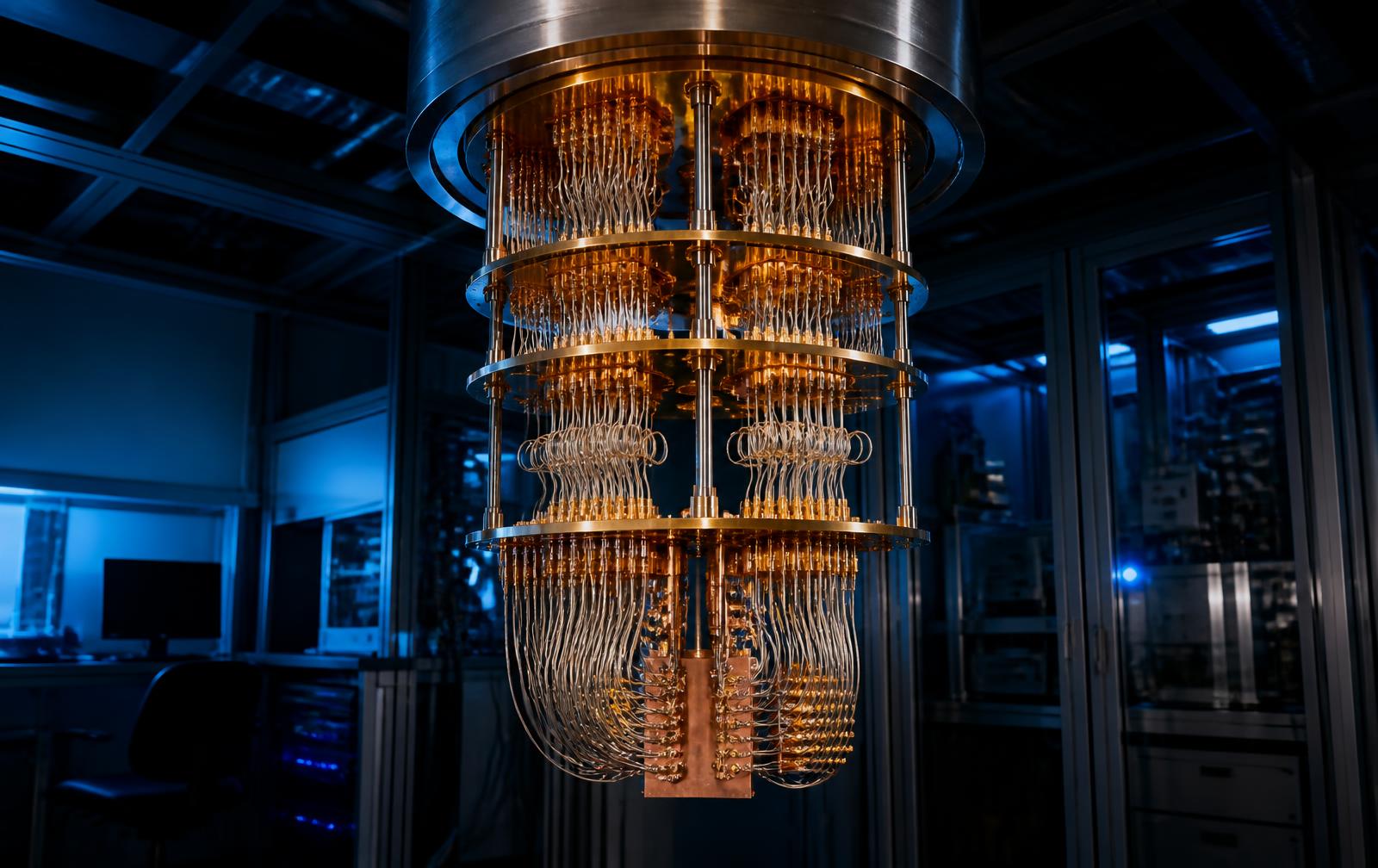
Why Quantum Phase Estimation Is Powerful but Resource-Intensive
Quantum phase estimation extracts eigenvalues encoded as phases, but its practical value depends on accurate state preparation, long coherent circuits and efficient controlled operations.
By The Quantum Lab desk
Written in-house by the The Quantum Lab desk — an explainer, not a report of a news event.
- Phase estimation converts an eigenvalue problem into the measurement of a quantum phase.
- Higher precision requires longer controlled evolutions and greater resistance to accumulated error.
- Practical implementations often trade ancillary qubits for additional circuit repetitions and classical processing.
Quantum phase estimation is a core subroutine for learning an eigenvalue of a unitary operation. If a state |ψ⟩ is an eigenstate of a unitary U, applying U changes that state only by a phase factor whose angle encodes the associated eigenvalue. The algorithm transfers information about that otherwise unobservable phase into measurable qubits.
In the standard circuit, ancillary qubits control repeated applications of U raised to successive powers. An inverse quantum Fourier transform then converts the accumulated phase relationships into a binary estimate. Measuring the ancillas yields an approximation whose precision is set by the number of phase bits extracted.
The method is relevant to quantum simulation because energy levels can be connected to phases generated by time evolution under a Hamiltonian. However, this requires implementing controlled time evolution accurately, which may involve many gates or specialized simulation techniques. Greater numerical precision generally demands longer evolution times and deeper coherent circuits.
State preparation is another central constraint. If the input is not an exact eigenstate, phase estimation can return different eigenvalues with probabilities determined by the input state's overlap with the corresponding eigenstates. Preparing a state with substantial overlap may itself be difficult, especially for strongly correlated systems.
Variants such as iterative and semiclassical phase estimation reduce the number of ancillary qubits by reusing qubits, measurements and classical feed-forward. These approaches do not remove the need for accurate controlled evolution, and they may require more repetitions. Phase estimation is therefore best understood as a precise algorithmic framework whose usefulness depends heavily on the cost of its physical and mathematical building blocks.
This story started as a thread in our Discord. Join the discussion with the researchers and engineers who work on it.
Related
Open-source compiler cuts logical-qubit overhead by a third
A new lattice-surgery scheduler squeezes routing overhead out of fault-tolerant circuits, and it ships under a permissive license.
A shared benchmark suite for logical qubits gets a first draft
Vendors publish incomparable numbers. A working group wants one protocol everyone can run.
Surface-code processor stays below threshold as it scales to 1,000 qubits
The logical error rate keeps falling as the code distance grows — the clearest sign yet that adding qubits now buys reliability instead of noise.