
Why Quantum Networks Need Microwave-to-Optical Transducers
Microwave-to-optical transduction aims to connect superconducting quantum processors with low-loss optical communication links, but preserving fragile quantum states during conversion remains a major engineering challenge.
By The Quantum Lab desk
Written in-house by the The Quantum Lab desk — an explainer, not a report of a news event.
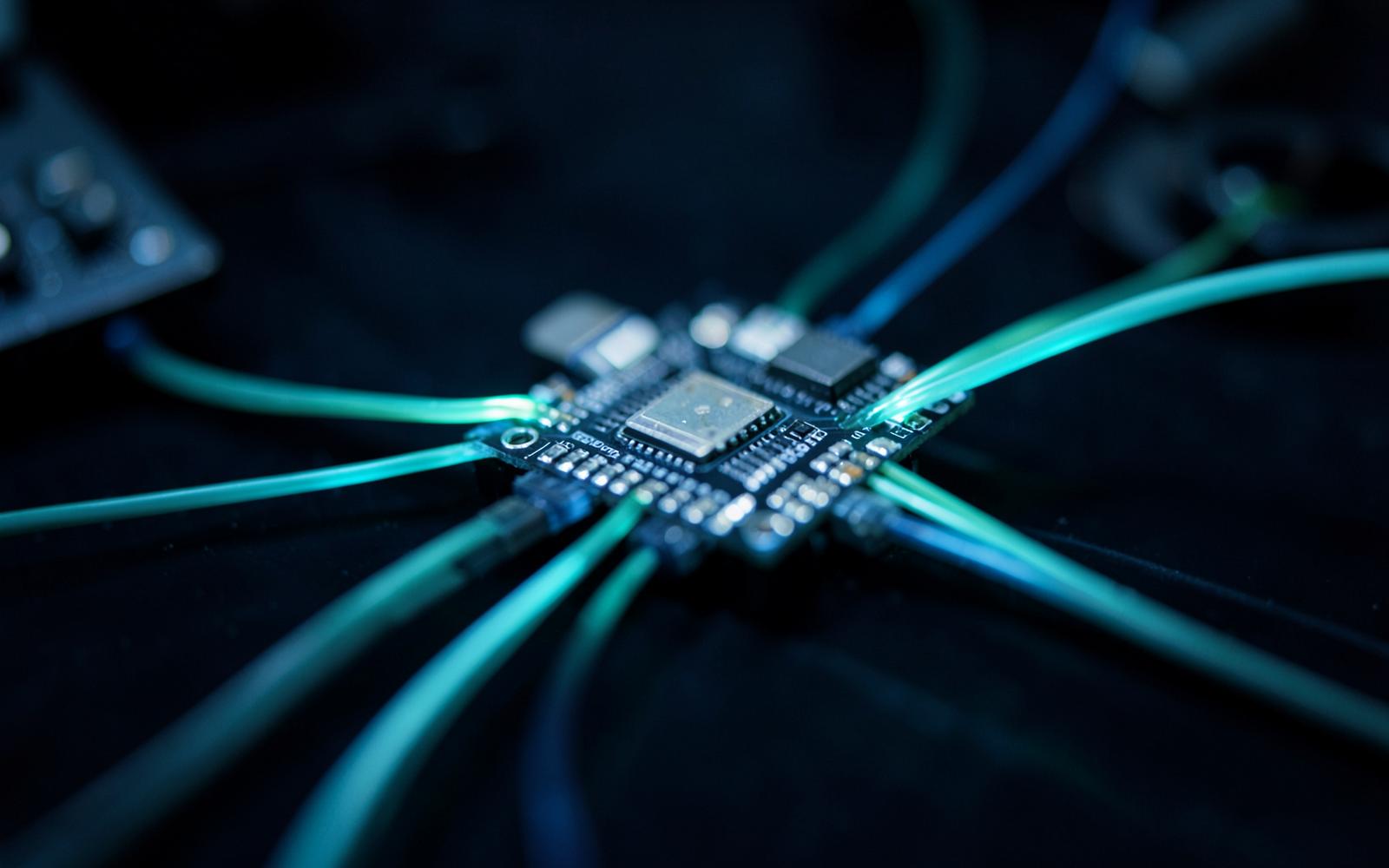
- A quantum transducer converts the physical carrier of a quantum state without measuring or copying the encoded information.
- Useful devices must combine high conversion efficiency with extremely low added noise.
- Pump heating, signal loss and imperfect coupling currently complicate integration with superconducting processors.
Superconducting qubits are controlled and read out using microwave-frequency signals, while optical photons are better suited to carrying quantum information over long distances. Optical fiber absorbs microwave radiation strongly but can guide light with comparatively low loss. A microwave-to-optical transducer is therefore a possible interface between cryogenic processors and optical quantum networks.
The goal is not merely to translate a classical signal from one frequency to another. A transducer must transfer quantum information, including superpositions and entanglement, without learning or copying the state. Because unknown quantum states cannot be cloned, ordinary amplification followed by retransmission cannot provide an equivalent interface.
Several conversion methods are under study. Electro-optic devices couple microwave and optical fields through a material whose refractive properties respond to an electric field, while optomechanical systems use vibrations as an intermediary between the two frequency ranges. In either case, strong pump fields are often used to enhance interactions that are otherwise too weak for efficient conversion.
Efficiency alone is not enough: loss can replace the desired photon with vacuum, while thermal excitations or pump-induced effects can add noise. Mechanical components are especially sensitive to thermal occupation, and superconducting circuits can be disturbed by heat or stray optical light. Bandwidth, coupling losses and compatibility with cryogenic packaging also affect the performance of a complete link.
Researchers therefore assess transducers using system-level measures such as end-to-end conversion efficiency, added noise and the fidelity of transferred quantum states. A practical interface would need to meet these requirements simultaneously while operating near sensitive qubits. Until then, microwave-to-optical conversion remains an enabling hardware problem rather than a transparent networking component.
This story started as a thread in our Discord. Join the discussion with the researchers and engineers who work on it.
Related
Surface-code processor stays below threshold as it scales to 1,000 qubits
The logical error rate keeps falling as the code distance grows — the clearest sign yet that adding qubits now buys reliability instead of noise.
Trapped-ion shuttling record pushes two-qubit fidelity past 99.9%
Moving ions between zones used to cost coherence. A revised trap geometry makes transport nearly free.
Open-source compiler cuts logical-qubit overhead by a third
A new lattice-surgery scheduler squeezes routing overhead out of fault-tolerant circuits, and it ships under a permissive license.