Why Quantum Gates Require Continuous Calibration
Quantum gates are implemented by precisely shaped physical control signals, not abstract instructions alone. Because qubits and their environments drift over time, maintaining accurate operations requires repeated measurement, adjustment and validation.
By The Quantum Lab desk
Written in-house by the The Quantum Lab desk — an explainer, not a report of a news event.
- A quantum gate is a calibrated physical interaction rather than a perfectly fixed logical command.
- Small changes in qubits, control electronics or the surrounding environment can reduce gate accuracy.
- Calibration must balance measurement thoroughness against the time during which the processor remains stable.
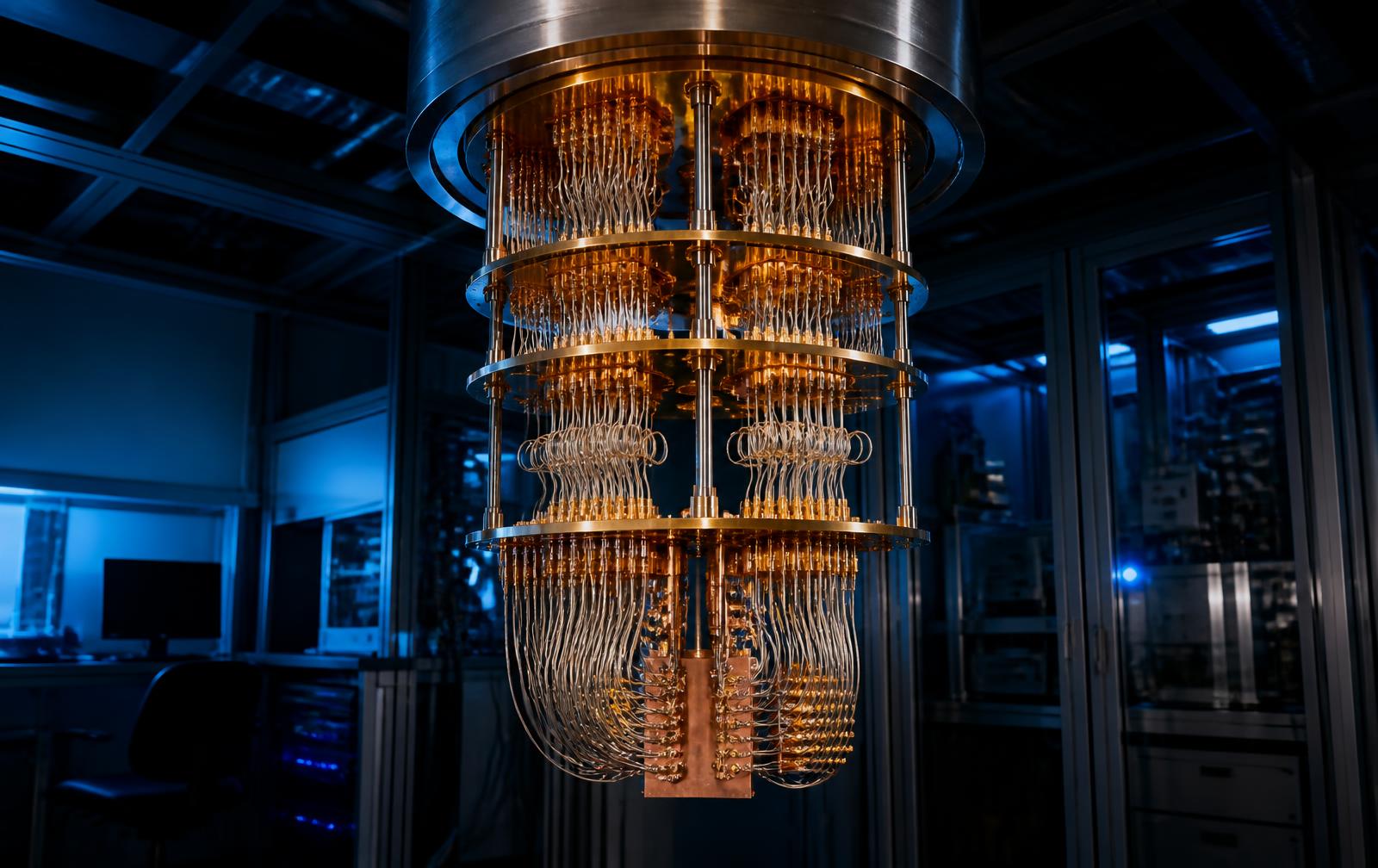
In circuit diagrams, quantum gates appear as ideal mathematical operations applied to qubits. On real hardware, each gate is produced by a physical control signal, such as a microwave pulse, laser sequence or changing electrical flux. Its frequency, amplitude, duration and phase must be tuned to drive the intended evolution without causing unwanted transitions.
The correct settings are not permanently fixed. Qubit frequencies and coupling strengths can shift because of temperature variations, charge fluctuations, magnetic noise, material defects or changes in control electronics. Even small drifts can accumulate across a long circuit and lower the probability of obtaining the intended result.
Calibration usually begins by running diagnostic experiments whose outcomes reveal particular control errors. Engineers may sweep a pulse parameter, repeat a gate many times to amplify a small imperfection, or compare sequences designed to distinguish errors in rotation angle from errors in phase. The resulting data feed optimization routines that update the control settings.
Gate parameters also interact, making calibration more difficult than tuning each operation independently. A pulse adjusted for one qubit can disturb a neighbor through crosstalk, while a two-qubit gate may depend on single-qubit frequencies, coupler settings and timing alignment. Improving one metric can therefore worsen another unless calibration accounts for the processor as a coupled system.
The central operational challenge is that characterization takes time while the hardware continues to drift. Fast checks may miss subtle correlated errors, but exhaustive tests can consume much of the machine’s available runtime. Practical systems consequently combine scheduled recalibration, automated drift monitoring and targeted validation to keep gate performance within usable bounds.
This story started as a thread in our Discord. Join the discussion with the researchers and engineers who work on it.
Related
Surface-code processor stays below threshold as it scales to 1,000 qubits
The logical error rate keeps falling as the code distance grows — the clearest sign yet that adding qubits now buys reliability instead of noise.
Trapped-ion shuttling record pushes two-qubit fidelity past 99.9%
Moving ions between zones used to cost coherence. A revised trap geometry makes transport nearly free.
Open-source compiler cuts logical-qubit overhead by a third
A new lattice-surgery scheduler squeezes routing overhead out of fault-tolerant circuits, and it ships under a permissive license.