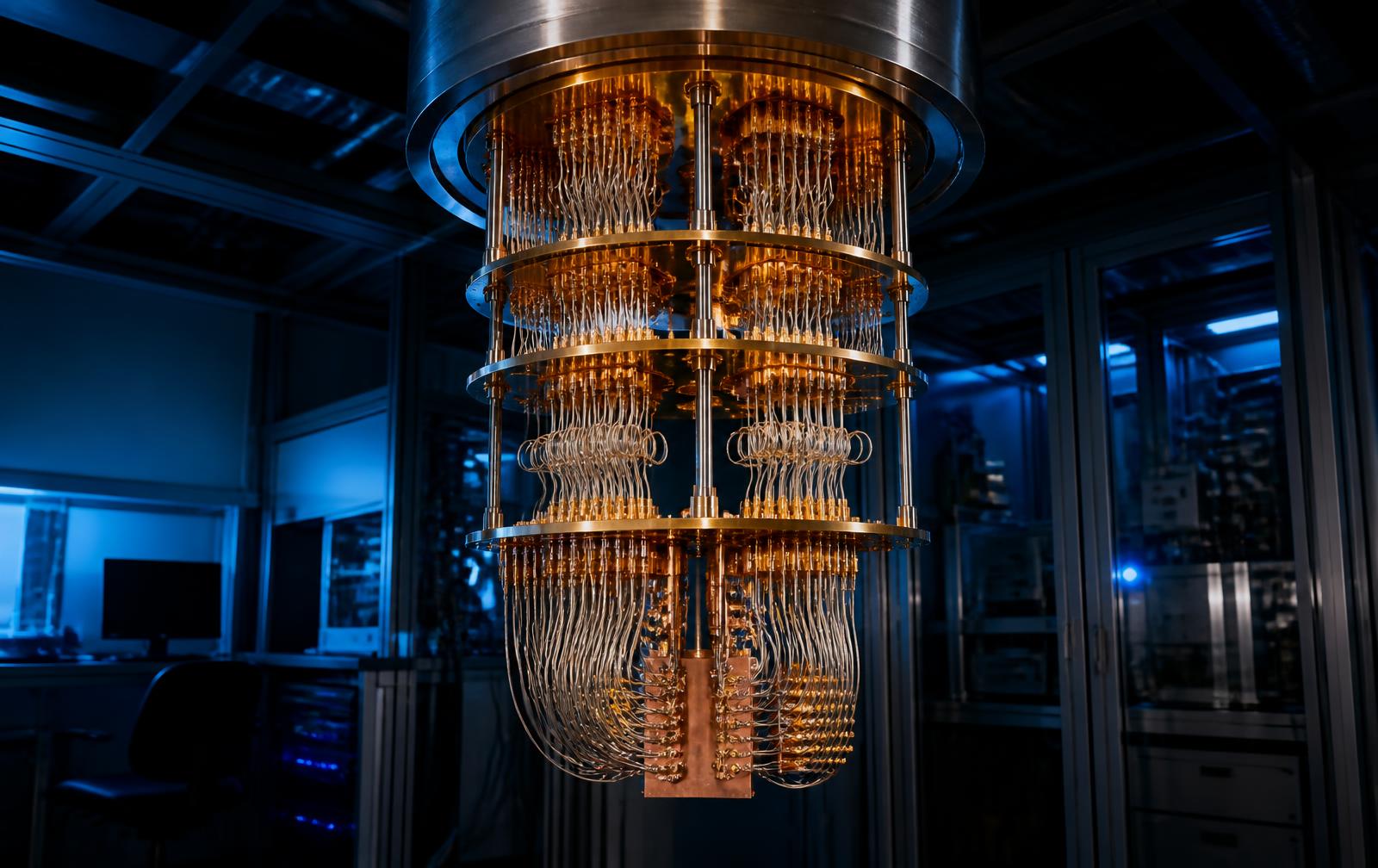
Why Quantum Algorithms Need Reversible Arithmetic
Quantum algorithms often require familiar calculations such as addition, multiplication and function evaluation, but those operations must be redesigned to preserve quantum information.
By The Quantum Lab desk
Written in-house by the The Quantum Lab desk — an explainer, not a report of a news event.
- Quantum arithmetic must usually be implemented as a reversible transformation rather than a conventional overwrite operation.
- Temporary results must be uncomputed to prevent unwanted entanglement from corrupting interference.
- Arithmetic circuit design can strongly influence the qubit count and runtime of a fault-tolerant quantum algorithm.
Ordinary processors routinely erase or overwrite intermediate values, making many classical computations logically irreversible. A coherent quantum circuit, by contrast, evolves through unitary operations that preserve information and can be inverted. This constraint changes how arithmetic and other classical subroutines are embedded in quantum algorithms.
A classical function can be made reversible by retaining its input and writing the result into a separate register. A common construction maps a state |x,y⟩ to |x,y XOR f(x)⟩, which remains one-to-one even when f itself is not invertible. When x is in a superposition, the circuit evaluates the function coherently across all components without producing a directly readable list of answers.
Reversible arithmetic often uses ancillary qubits to store carries, partial products or other temporary data. Leaving those values in place can entangle them with the desired output and prevent later interference from working as intended. Algorithms therefore commonly copy or use the needed result and then run the arithmetic circuit backward to return temporary registers to a known state, a procedure called uncomputation.
There are multiple reversible designs for addition, multiplication and comparison, each balancing circuit depth, qubit count and gate types. A ripple-carry adder may use relatively modest hardware but propagate information sequentially, while more parallel designs can reduce depth at the cost of additional qubits and operations. The best choice depends on the architecture and on whether qubits or execution time are the tighter constraint.
These trade-offs become especially important in fault-tolerant computing, where non-Clifford operations such as T gates are generally more expensive than Clifford gates. Arithmetic-heavy algorithms may require many such operations, so optimizing number representation, precision and uncomputation can materially change total resource estimates. Reversible arithmetic is therefore not merely a translation detail; it is a central part of practical quantum algorithm design.
This story started as a thread in our Discord. Join the discussion with the researchers and engineers who work on it.
Related
Open-source compiler cuts logical-qubit overhead by a third
A new lattice-surgery scheduler squeezes routing overhead out of fault-tolerant circuits, and it ships under a permissive license.
A shared benchmark suite for logical qubits gets a first draft
Vendors publish incomparable numbers. A working group wants one protocol everyone can run.
Surface-code processor stays below threshold as it scales to 1,000 qubits
The logical error rate keeps falling as the code distance grows — the clearest sign yet that adding qubits now buys reliability instead of noise.