Why Material Interfaces Limit Superconducting Qubit Coherence
Superconducting circuits can store quantum information in microwave excitations, but microscopic defects at surfaces and interfaces provide pathways for that energy and phase information to escape.
By The Quantum Lab desk
Written in-house by the The Quantum Lab desk — an explainer, not a report of a news event.
- Superconducting qubits are unusually sensitive to thin, imperfect material interfaces where electric fields concentrate.
- Microscopic two-level defects can absorb energy or fluctuate in ways that disrupt qubit coherence.
- Reducing interface loss requires coordinated improvements in materials, fabrication, circuit geometry and measurement.
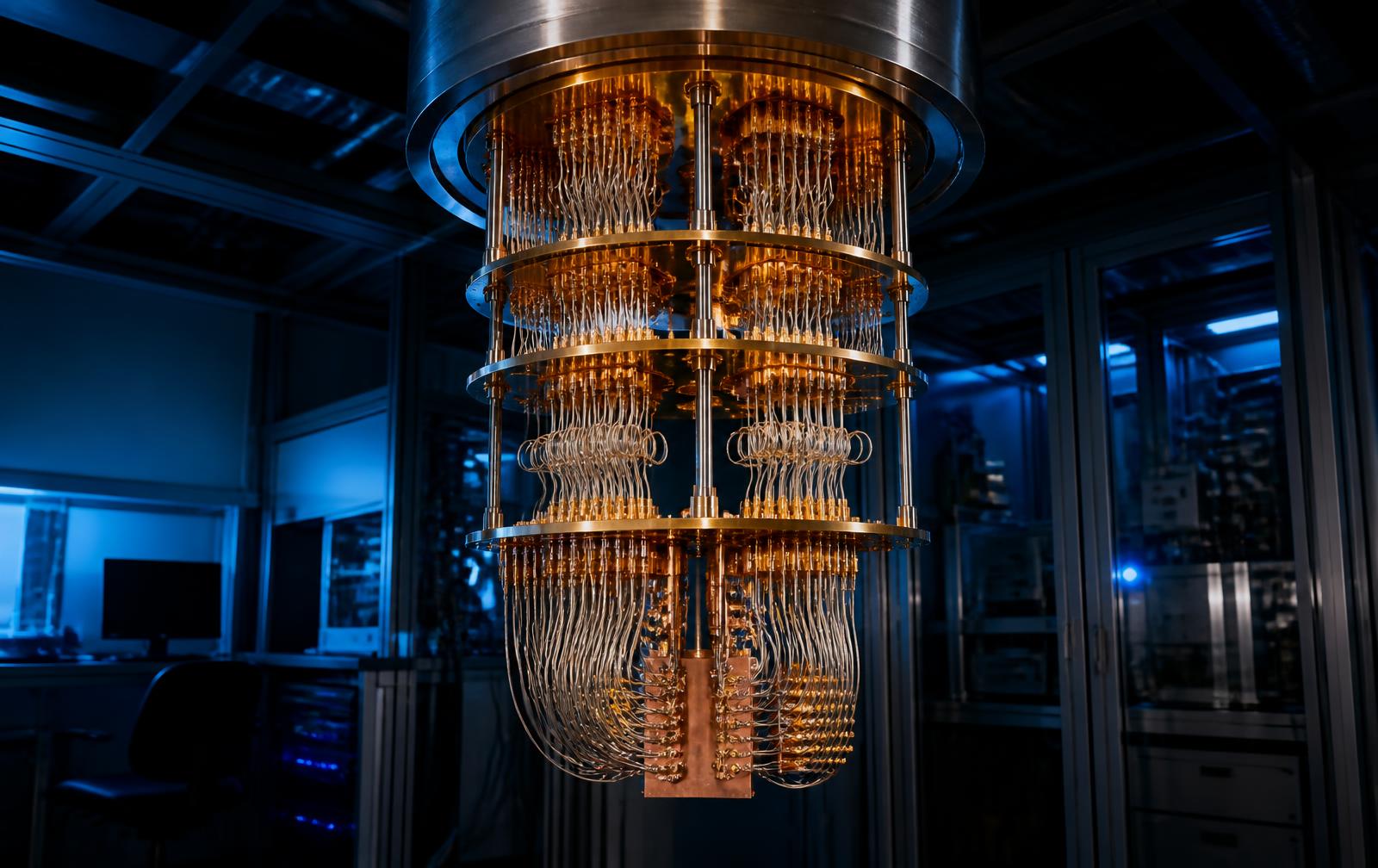
A superconducting qubit is an engineered electrical circuit whose lowest energy levels encode quantum information. Although its conductors can carry current without ordinary electrical resistance, the complete device is not lossless. Electric fields extend into substrates, insulating layers, oxides and interfaces, allowing those regions to influence the qubit’s lifetime.
A major concern is dielectric loss associated with microscopic defects that behave approximately like two-level quantum systems. These defects can couple to a qubit’s electric field, absorb energy from it and sometimes return that energy unpredictably. Their microscopic origins vary, but disordered oxides, contaminants and structural irregularities at material boundaries are common suspects.
Interface defects can also contribute to frequency noise rather than directly removing energy. Slow fluctuations in nearby charges or defect configurations shift the qubit transition frequency, causing different runs of an experiment to accumulate different phases. This dephasing reduces coherence even when the qubit remains in its excited state.
Engineers address these effects by changing both fabrication and circuit design. Cleaning procedures, deposition conditions, substrate preparation and careful control of oxidation can reduce contamination or disorder, while larger capacitor features can spread electric fields away from especially lossy regions. These approaches involve trade-offs because geometry also affects device size, coupling strength and susceptibility to other noise sources.
Diagnosing interface loss is difficult because several mechanisms can produce similar coherence measurements. Researchers compare devices with different materials and geometries, measure how loss changes with temperature or field strength, and use dedicated resonators to characterize fabrication processes. The resulting evidence guides incremental improvements, but it does not reduce the problem to a single universally dominant defect or interface.
This story started as a thread in our Discord. Join the discussion with the researchers and engineers who work on it.
Related
Surface-code processor stays below threshold as it scales to 1,000 qubits
The logical error rate keeps falling as the code distance grows — the clearest sign yet that adding qubits now buys reliability instead of noise.
Trapped-ion shuttling record pushes two-qubit fidelity past 99.9%
Moving ions between zones used to cost coherence. A revised trap geometry makes transport nearly free.
Open-source compiler cuts logical-qubit overhead by a third
A new lattice-surgery scheduler squeezes routing overhead out of fault-tolerant circuits, and it ships under a permissive license.