Why Cryogenic Wiring Is a Scaling Challenge for Quantum Computers
Superconducting quantum processors require extensive control and readout wiring, but every connection into a cryostat can introduce heat, noise and physical complexity.
By The Quantum Lab desk
Written in-house by the The Quantum Lab desk — an explainer, not a report of a news event.
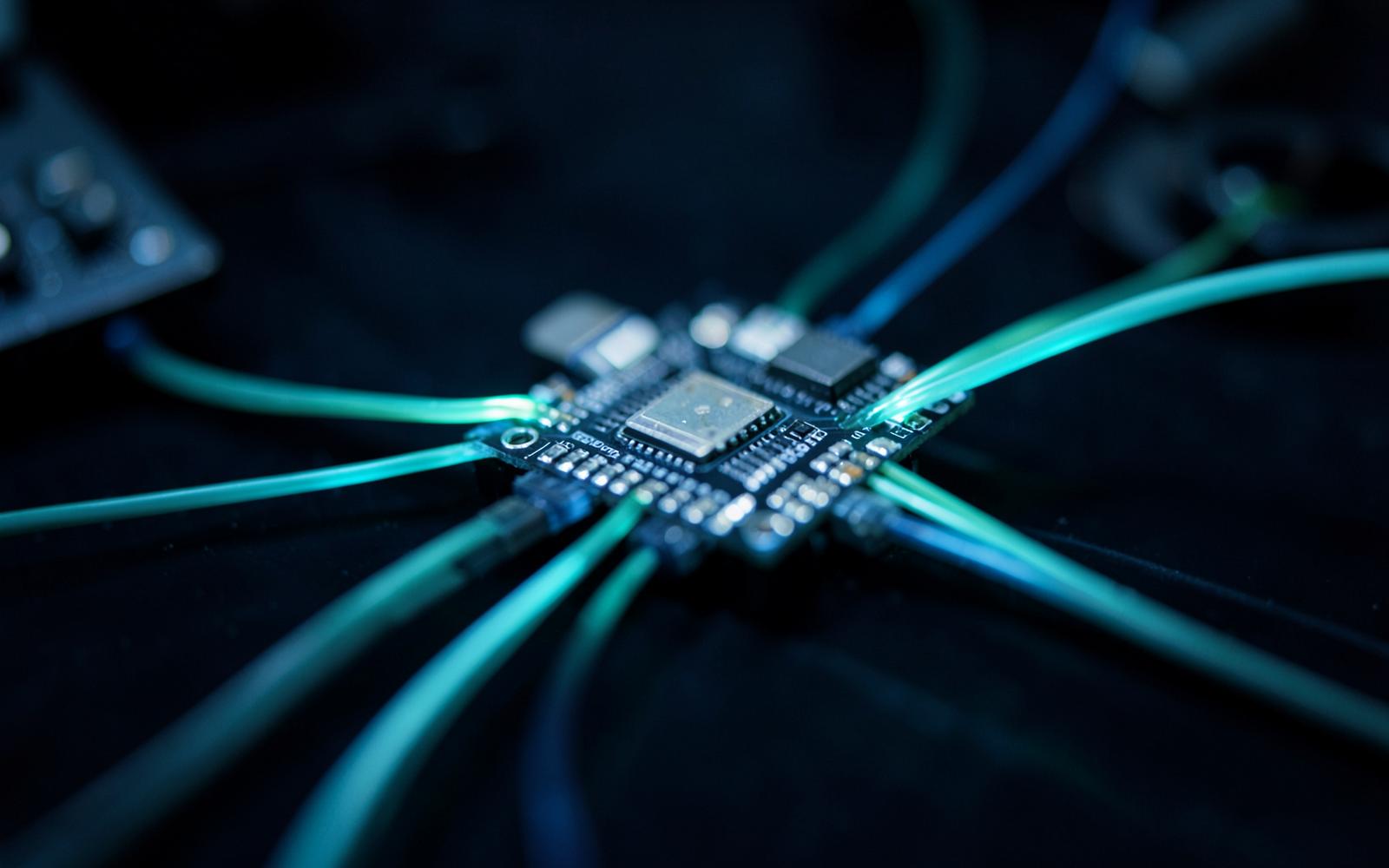
- Cryogenic wiring must carry precise signals without overwhelming colder stages with heat or noise.
- Attenuators, filters and amplifiers improve signal quality but consume space and cooling capacity.
- Multiplexing and cryogenic control electronics could reduce cabling, though they introduce their own engineering trade-offs.
Superconducting qubits operate at temperatures where thermal energy is low enough to suppress unwanted excitations. They are controlled with microwave pulses and measured through resonators, requiring signal paths between room-temperature electronics and the processor inside a dilution refrigerator. As systems grow, routing those paths becomes a major engineering constraint.
Each cable conducts some heat from warmer regions toward the coldest stage. Engineers limit this heat flow by selecting suitable materials, anchoring cables at intermediate temperature stages and adding components that suppress room-temperature noise. These measures protect the qubits but also occupy space and add to the refrigerator’s cooling load.
Control lines commonly include attenuators and filters, while readout chains use isolating components and low-noise amplifiers. The arrangement must preserve weak quantum signals while preventing amplifier noise and stray radiation from reaching the processor. Poorly designed wiring can reduce coherence, distort control pulses or make measurements less reliable.
One route to scaling is multiplexing, in which several qubits share parts of a control or readout channel. Another is to place more classical electronics inside the cryostat, shortening connections to the processor. Both approaches trade reduced cable count against challenges such as power dissipation, signal crosstalk, bandwidth limits and operation at low temperature.
Cryogenic wiring is therefore part of the quantum computer’s architecture rather than a peripheral packaging issue. Progress depends on coordinating processor design, microwave engineering, thermal management and classical control. A larger qubit count is useful only if the system can deliver and recover signals without degrading qubit performance.
This story started as a thread in our Discord. Join the discussion with the researchers and engineers who work on it.
Related
Surface-code processor stays below threshold as it scales to 1,000 qubits
The logical error rate keeps falling as the code distance grows — the clearest sign yet that adding qubits now buys reliability instead of noise.
Trapped-ion shuttling record pushes two-qubit fidelity past 99.9%
Moving ions between zones used to cost coherence. A revised trap geometry makes transport nearly free.

Open-source compiler cuts logical-qubit overhead by a third
A new lattice-surgery scheduler squeezes routing overhead out of fault-tolerant circuits, and it ships under a permissive license.