Why Cryogenic Wiring Is a Scaling Challenge for Quantum Computers
Superconducting quantum processors require carefully engineered connections between room-temperature electronics and millikelvin qubits, creating trade-offs among signal quality, thermal noise and cooling capacity.
By The Quantum Lab desk
Written in-house by the The Quantum Lab desk — an explainer, not a report of a news event.
- Control cables must deliver precise signals without carrying excessive heat or noise to the qubits.
- Attenuators, filters and thermal anchoring protect qubits but also consume cooling power and weaken signals.
- Scaling may require a combination of improved wiring, multiplexing and cryogenic control electronics.
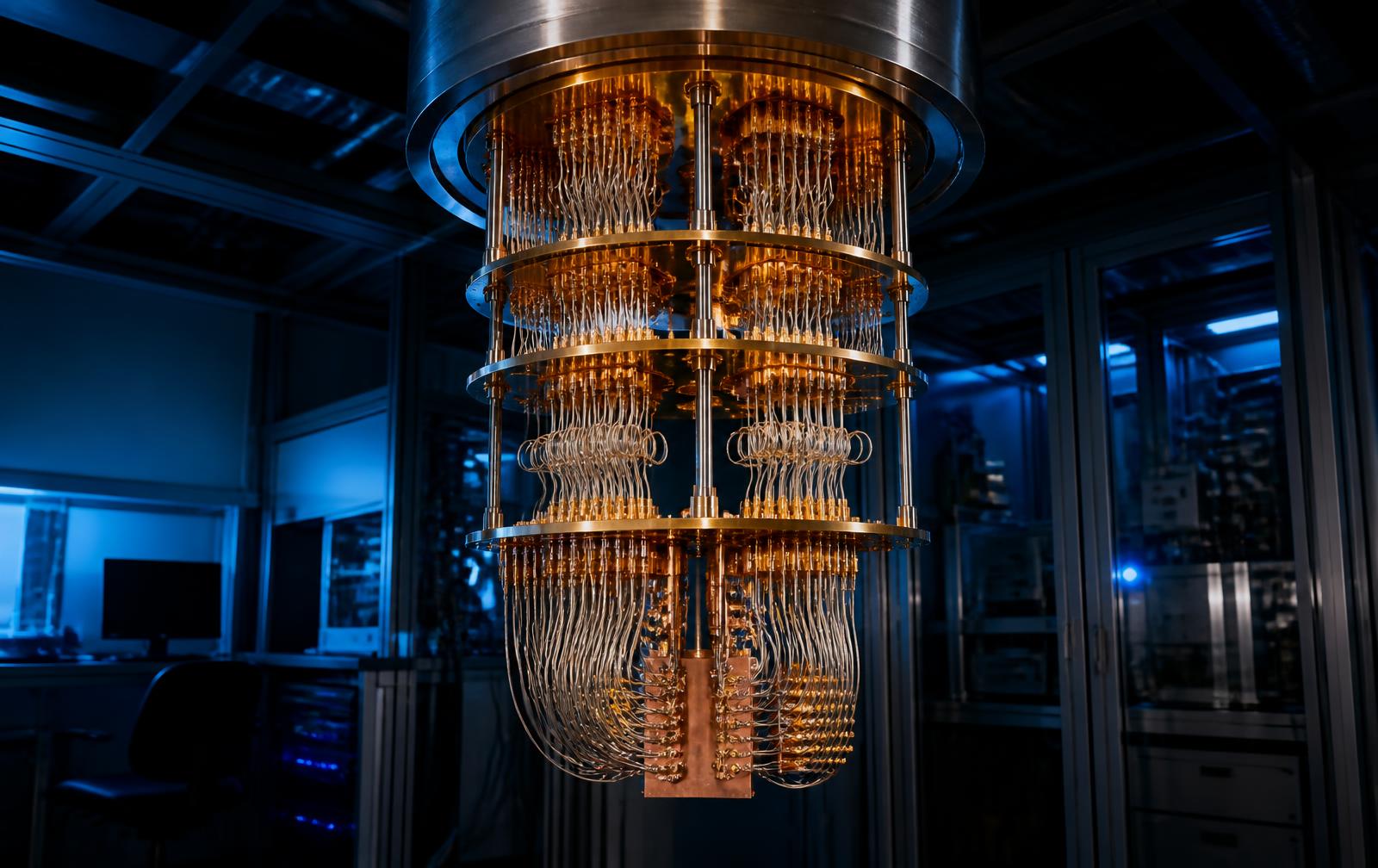
Superconducting qubits typically operate in dilution refrigerators at temperatures of a few tens of millikelvin, while much of their control electronics remains at room temperature. Microwave cables and readout lines must cross this large temperature gradient. Each connection can conduct heat toward the processor and provide a path for unwanted electromagnetic noise.
A room-temperature microwave line contains thermal noise that would disturb a qubit if it reached the coldest stage unchanged. Engineers therefore install attenuators and filters at several refrigerator stages, reducing noise while anchoring the cable thermally. The placement and strength of these components must preserve the control pulses needed for accurate operations.
Attenuation creates its own engineering trade-off because weaker signals require more power at the source, and some of that power is dissipated inside the refrigerator. Readout output lines present a different problem: they must preserve faint measurement signals while blocking noise traveling back from warmer amplifiers. Components such as isolators, circulators and cryogenic amplifiers help manage this directionality, but they occupy space and add heat load.
The challenge becomes more severe as qubit counts grow because conventional architectures can require many dedicated cables and microwave components. A dilution refrigerator has limited physical space and sharply limited cooling power at its coldest stage. Connectors, cable routing and assembly reliability can therefore become constraints alongside qubit fabrication and coherence.
Possible scaling approaches include sharing lines through multiplexing, reducing the number of room-temperature connections and moving some control electronics into the cryogenic environment. Cryogenic electronics can shorten signal paths and simplify wiring, but their power dissipation and noise must remain compatible with qubit operation. No single approach removes the thermal budget, so wiring architecture must be designed as part of the quantum processor rather than as an external support system.
This story started as a thread in our Discord. Join the discussion with the researchers and engineers who work on it.
Related
Surface-code processor stays below threshold as it scales to 1,000 qubits
The logical error rate keeps falling as the code distance grows — the clearest sign yet that adding qubits now buys reliability instead of noise.
Trapped-ion shuttling record pushes two-qubit fidelity past 99.9%
Moving ions between zones used to cost coherence. A revised trap geometry makes transport nearly free.

Open-source compiler cuts logical-qubit overhead by a third
A new lattice-surgery scheduler squeezes routing overhead out of fault-tolerant circuits, and it ships under a permissive license.