Why Cryogenic Wiring Is a Quantum Hardware Bottleneck
Scaling cryogenic quantum processors requires engineers to deliver many precise control and readout signals without overwhelming the refrigerator with heat, noise or physical wiring.
By The Quantum Lab desk
Written in-house by the The Quantum Lab desk — an explainer, not a report of a news event.
- Every wire entering a cryogenic system can carry both useful signals and unwanted heat or noise.
- Attenuators, filters and thermal anchoring protect qubits but complicate signal delivery and system integration.
- Multiplexing and cryogenic control electronics could reduce wiring demands, although they introduce their own power and noise constraints.
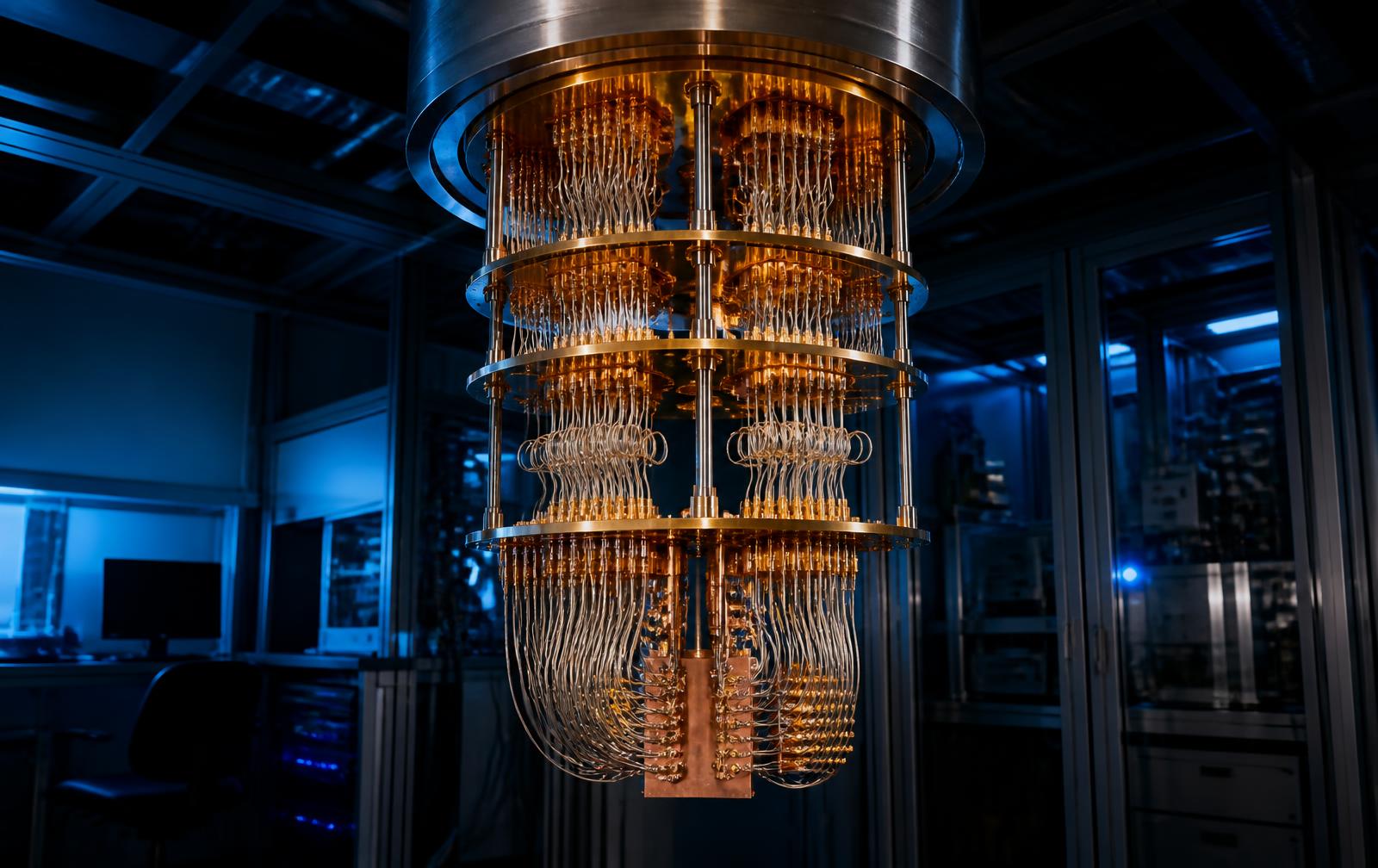
Many quantum processors operate inside dilution refrigerators, where the coldest stage is maintained at temperatures of only a few tens of millikelvin. Qubits at this stage must still communicate with room-temperature waveform generators, amplifiers and data-acquisition equipment. The resulting control and readout lines form a growing engineering bottleneck as qubit counts increase.
A cable is not merely an electrical connection: it is also a path for heat to flow from warmer parts of the refrigerator toward colder ones. Engineers therefore anchor cables thermally at several temperature stages and choose conductors that balance low signal loss against low thermal conductivity. The coldest stage has limited cooling power, so adding lines without careful thermal design can raise temperatures and degrade qubit performance.
Control lines can also carry thermal radiation and electronic noise that disturb fragile quantum states. Attenuators and low-pass or infrared filters suppress unwanted noise before it reaches the processor, while isolators and circulators can protect qubits from noise returning through readout chains. These components consume space, add insertion loss and must remain reliable through repeated cooling cycles.
Straightforward one-line-per-signal architectures become increasingly difficult to package at scale. Frequency multiplexing can place several readout channels on one transmission line, while routing schemes may allow selected control resources to be shared. Such approaches reduce cable counts but increase demands on bandwidth, calibration, signal separation and crosstalk management.
Another option is to move parts of the control system into the refrigerator using cryogenic classical electronics. Placing switches, multiplexers or waveform-generating circuits closer to the qubits can shorten connections and reduce the number of room-temperature cables. However, those circuits dissipate power and generate noise, so their benefits depend on careful placement at temperature stages with adequate cooling capacity.
This story started as a thread in our Discord. Join the discussion with the researchers and engineers who work on it.
Related
Surface-code processor stays below threshold as it scales to 1,000 qubits
The logical error rate keeps falling as the code distance grows — the clearest sign yet that adding qubits now buys reliability instead of noise.
Trapped-ion shuttling record pushes two-qubit fidelity past 99.9%
Moving ions between zones used to cost coherence. A revised trap geometry makes transport nearly free.

Open-source compiler cuts logical-qubit overhead by a third
A new lattice-surgery scheduler squeezes routing overhead out of fault-tolerant circuits, and it ships under a permissive license.