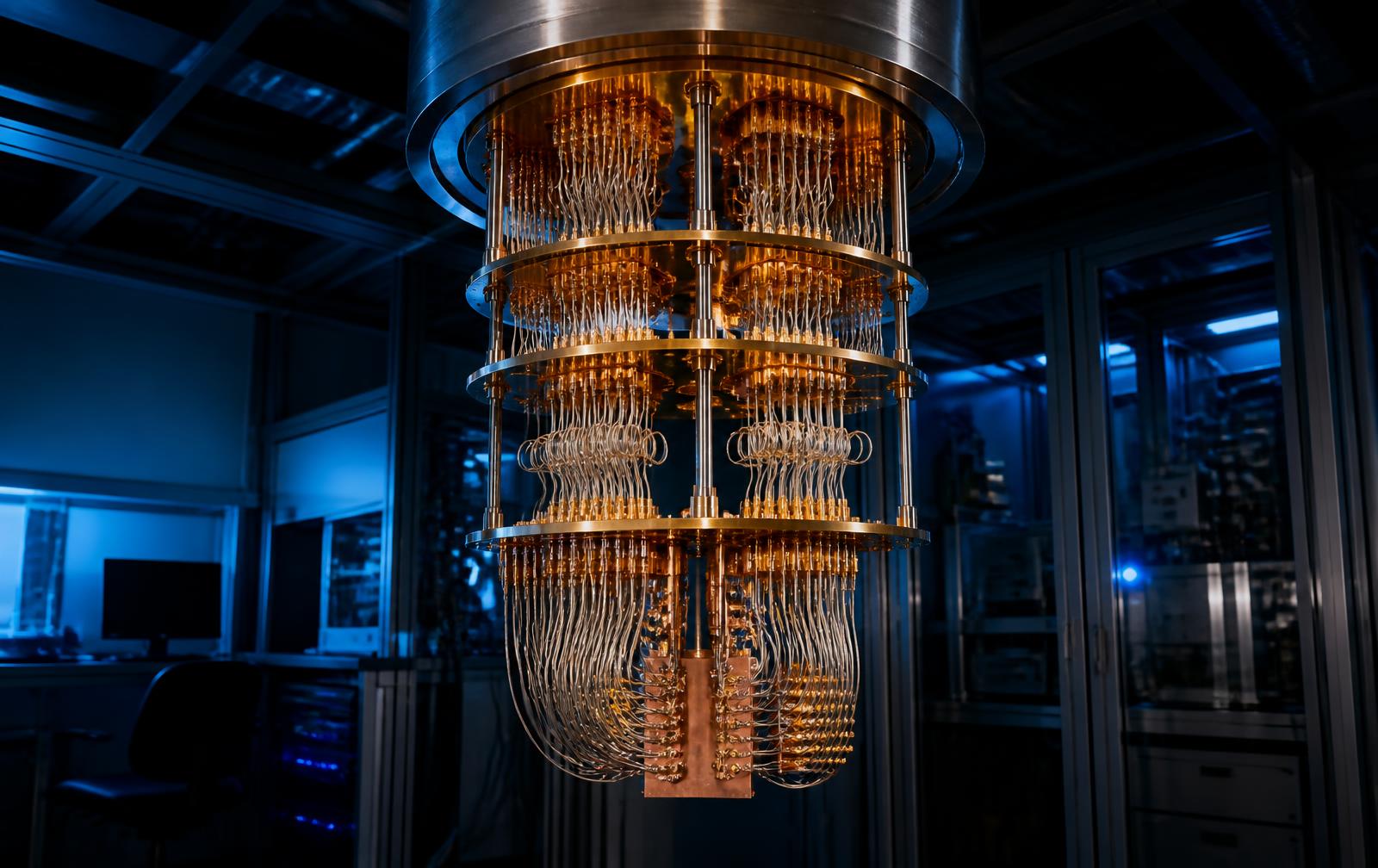
What Quantum Error Mitigation Can—and Cannot—Do
Quantum error mitigation uses statistical and mathematical techniques to estimate cleaner results from noisy quantum processors without fully correcting errors during computation.
By The Quantum Lab desk
Written in-house by the The Quantum Lab desk — an explainer, not a report of a news event.

- Error mitigation improves expectation-value estimates but does not create fault-tolerant quantum computation.
- Common methods trade additional circuit executions and modeling assumptions for reduced bias.
- Its usefulness depends on noise stability, circuit scale and the accuracy of classical post-processing.
Quantum processors accumulate errors from imperfect control, unwanted interactions and loss of coherence. Full quantum error correction aims to detect and correct such faults using encoded logical qubits, but that requires substantial hardware overhead. Error mitigation instead tries to infer what an ideal circuit would have produced from measurements made on noisy hardware.
Zero-noise extrapolation is one widely studied approach. A circuit is executed at several effective noise levels, produced for example by stretching control pulses or inserting operations that preserve the ideal computation, and the results are extrapolated toward the hypothetical zero-noise limit. The method relies on the noise being controllable and sufficiently regular for the extrapolation model to remain meaningful.
Probabilistic error cancellation takes a different route by first characterizing noisy operations and then combining results from modified circuits with positive and negative statistical weights. In principle, this can cancel modeled errors in expectation values. In practice, the required sampling can grow rapidly as circuits deepen or noise increases, because the weighted estimator develops large variance.
Other techniques target specific sources of bias. Readout-error mitigation calibrates how often measured states are misidentified, while symmetry verification discards or reweights outcomes that violate a known conservation law or constraint. Such methods can be effective when the relevant error mechanism is understood, but they cannot remove arbitrary faults.
Error mitigation therefore does not make a noisy device equivalent to a fault-tolerant computer. It can improve estimates for selected observables in circuits whose noise remains characterizable, at the cost of more measurements and classical computation. Any claimed improvement must be checked against calibration drift, statistical uncertainty and, where possible, classically verifiable benchmarks.
This story started as a thread in our Discord. Join the discussion with the researchers and engineers who work on it.
Related
Open-source compiler cuts logical-qubit overhead by a third
A new lattice-surgery scheduler squeezes routing overhead out of fault-tolerant circuits, and it ships under a permissive license.
A shared benchmark suite for logical qubits gets a first draft
Vendors publish incomparable numbers. A working group wants one protocol everyone can run.
Surface-code processor stays below threshold as it scales to 1,000 qubits
The logical error rate keeps falling as the code distance grows — the clearest sign yet that adding qubits now buys reliability instead of noise.