
How Tunable Couplers Control Interactions Between Superconducting Qubits
Tunable couplers let superconducting processors switch qubit interactions on for gates and suppress them during idle periods, reducing unwanted entanglement at the cost of added control complexity.
By The Quantum Lab desk
Written in-house by the The Quantum Lab desk — an explainer, not a report of a news event.
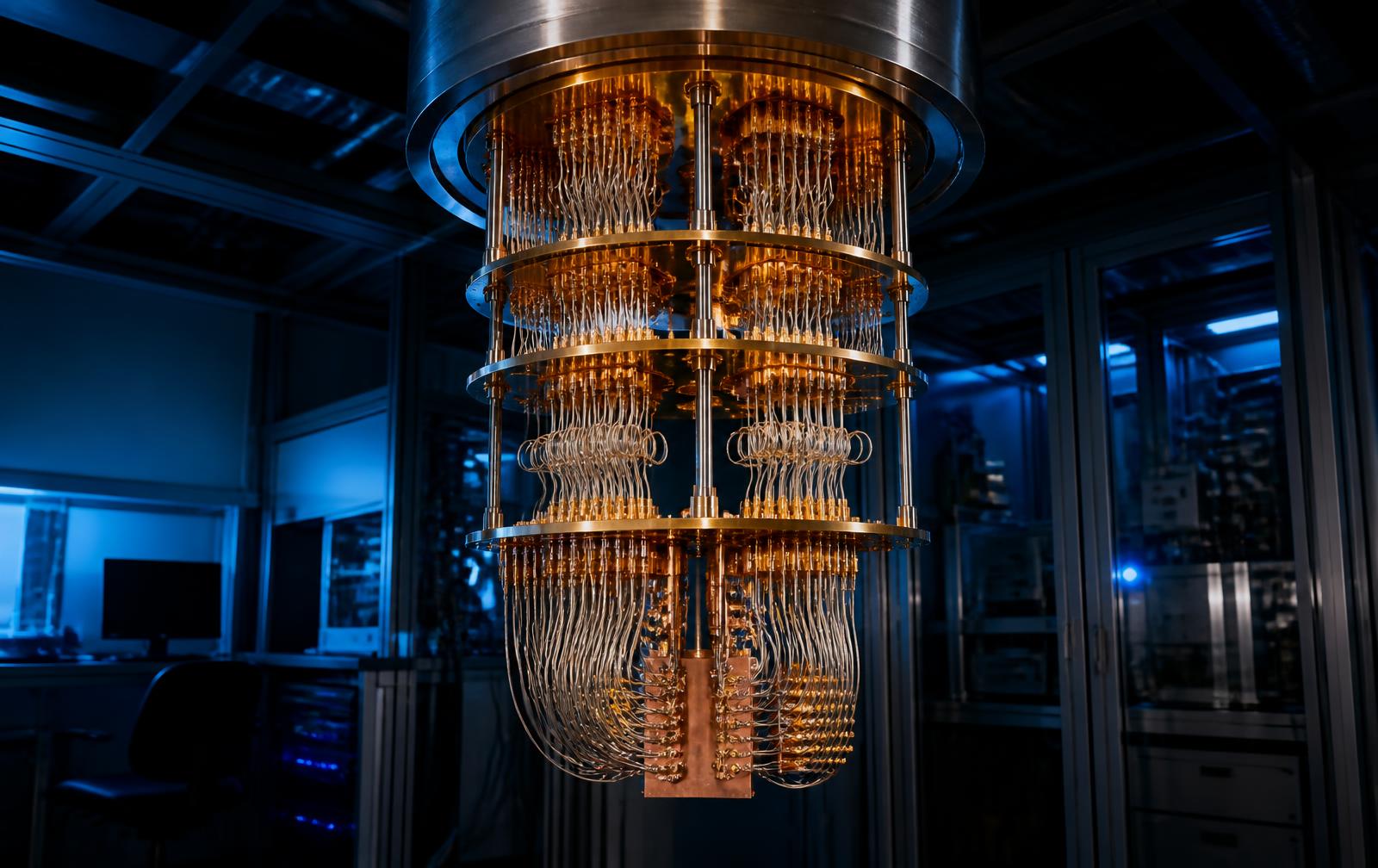
- A tunable coupler mediates an adjustable interaction between neighboring superconducting qubits.
- Biasing the coupler can reduce residual coupling during idle periods and strengthen it during two-qubit gates.
- Couplers improve control flexibility but introduce additional noise, leakage and calibration challenges.
Neighboring superconducting qubits must interact to perform two-qubit gates, but a permanently strong connection also causes unwanted evolution when no gate is intended. This residual interaction can shift qubit frequencies, accumulate correlated phase errors and complicate parallel operations. A tunable coupler is an intermediate circuit element designed to adjust that interaction dynamically.
A common coupler uses a flux-tunable superconducting circuit placed between two fixed-frequency transmon qubits. The qubits exchange virtual excitations through the coupler, producing an effective interaction whose strength depends on the coupler's frequency. By changing an applied magnetic flux, control electronics can vary both the magnitude and, in some designs, the sign of that effective coupling.
During an idle period, the coupler can be biased near a point where different interaction pathways largely cancel. For a gate, a flux pulse moves the circuit away from that cancellation point, temporarily increasing the interaction or activating a chosen resonant process. The resulting dynamics can implement entangling operations such as controlled-phase or excitation-exchange gates.
The cancellation is not perfect because real devices contain direct capacitance, higher energy levels and fabrication variations. Fast flux pulses can also drive unwanted transitions, cause leakage outside the computational states or make the operation sensitive to waveform distortion. Engineers therefore shape pulses and calibrate coupler biases, amplitudes and timing alongside the qubits themselves.
Tunable couplers add circuit area, control lines and potential channels for flux noise and loss. Their value is an engineering tradeoff: they can reduce always-on crosstalk and support faster, more selective gates, but only if the added element remains sufficiently coherent and controllable. As processors grow, coupler performance must also remain consistent across many neighboring qubit pairs.
This story started as a thread in our Discord. Join the discussion with the researchers and engineers who work on it.
Related
Surface-code processor stays below threshold as it scales to 1,000 qubits
The logical error rate keeps falling as the code distance grows — the clearest sign yet that adding qubits now buys reliability instead of noise.
Trapped-ion shuttling record pushes two-qubit fidelity past 99.9%
Moving ions between zones used to cost coherence. A revised trap geometry makes transport nearly free.

Open-source compiler cuts logical-qubit overhead by a third
A new lattice-surgery scheduler squeezes routing overhead out of fault-tolerant circuits, and it ships under a permissive license.