
How Tunable Couplers Control Interactions Between Superconducting Qubits
Tunable couplers help superconducting processors switch qubit interactions on for gates and suppress them during idle periods, but they introduce additional calibration and noise challenges.
By The Quantum Lab desk
Written in-house by the The Quantum Lab desk — an explainer, not a report of a news event.
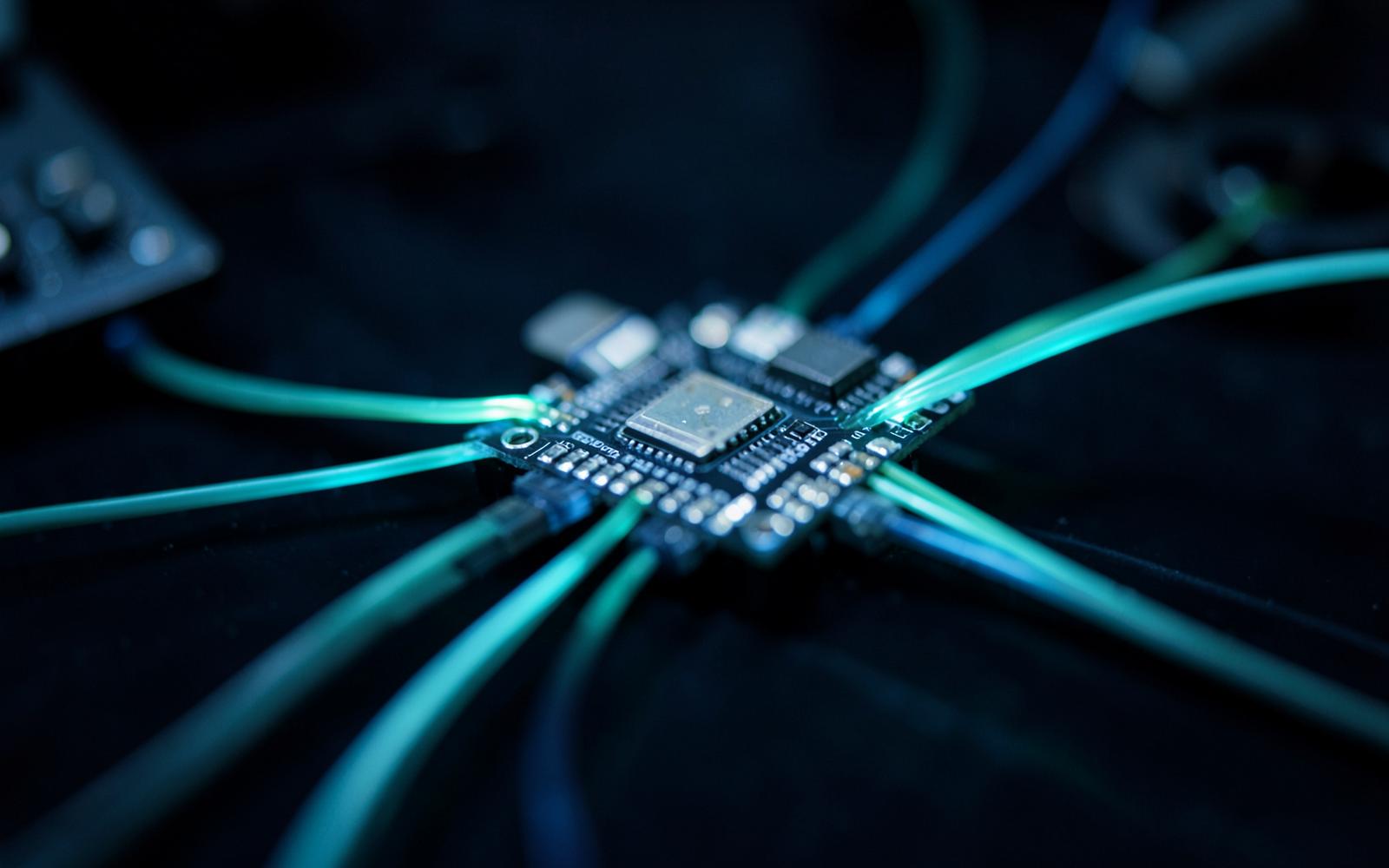
- Tunable couplers regulate the strength and form of interactions between neighboring qubits.
- Suppressing residual coupling reduces unwanted entanglement and correlated errors during idle periods.
- Couplers add control parameters, circuit modes and calibration demands to the processor.
Superconducting qubits must interact to perform two-qubit gates, yet persistent interaction can also create errors when no gate is intended. A tunable coupler is an intermediate circuit element whose operating point can be adjusted to strengthen, weaken or reshape the effective interaction between nearby qubits.
Many couplers are built from Josephson junction circuits that behave as nonlinear oscillators. Changing an applied magnetic flux shifts the coupler’s frequency and modifies the virtual exchange processes linking the qubits, allowing the net interaction to be tuned over a useful range and, in some designs, brought close to zero.
During a gate, a control pulse moves the coupler or the combined circuit through a trajectory that accumulates a desired conditional phase or enables excitation exchange. Outside the gate, the coupler is biased to suppress residual interactions that would otherwise shift qubit frequencies, generate unwanted phases or correlate errors across the device.
The coupler is not merely a passive switch. Its control line can introduce flux noise, pulse distortion and crosstalk, while rapid tuning can populate unwanted circuit levels or cause leakage from the computational subspace. Engineers therefore shape pulses and choose operating points to balance gate speed against sensitivity to noise and nonadiabatic transitions.
Calibration becomes more complicated as the processor grows because each coupler’s behavior depends on neighboring frequencies, control amplitudes and fabrication variation. Characterizing these dependencies requires measurements of interaction strength, conditional phase, leakage and residual coupling. Tunable couplers can improve control over multi-qubit dynamics, but their value depends on maintaining that control accurately across the full system.
This story started as a thread in our Discord. Join the discussion with the researchers and engineers who work on it.
Related
Surface-code processor stays below threshold as it scales to 1,000 qubits
The logical error rate keeps falling as the code distance grows — the clearest sign yet that adding qubits now buys reliability instead of noise.
Trapped-ion shuttling record pushes two-qubit fidelity past 99.9%
Moving ions between zones used to cost coherence. A revised trap geometry makes transport nearly free.

Open-source compiler cuts logical-qubit overhead by a third
A new lattice-surgery scheduler squeezes routing overhead out of fault-tolerant circuits, and it ships under a permissive license.