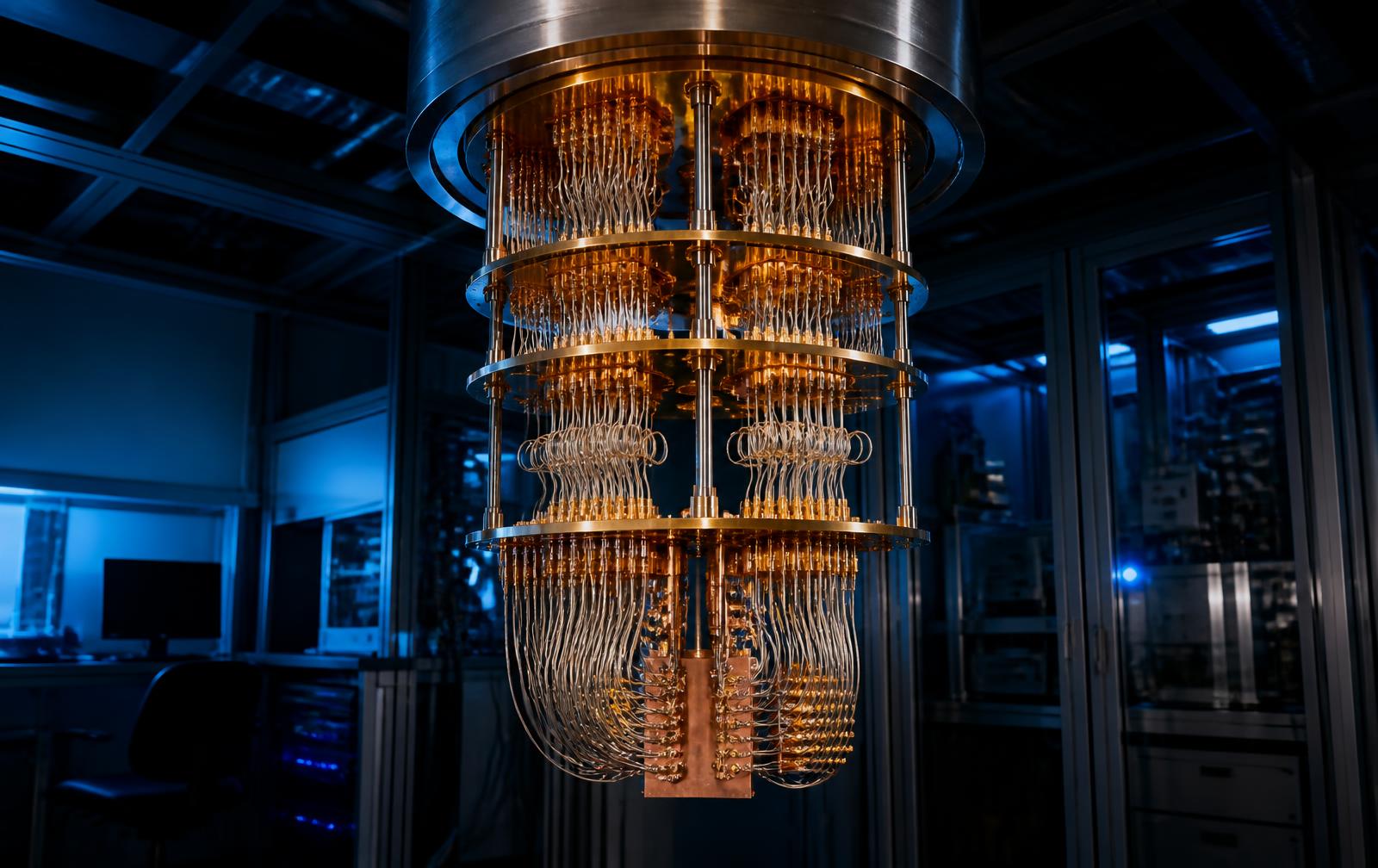
How Quantum Error-Correction Decoders Infer Hidden Faults
Quantum error-correction decoders turn indirect measurement data into estimates of where errors occurred and which corrective action will preserve encoded information.
By The Quantum Lab desk
Written in-house by the The Quantum Lab desk — an explainer, not a report of a news event.
- A decoder infers likely errors from syndrome measurements rather than directly inspecting the encoded quantum state.
- Different codes and noise models favor different decoding methods, including matching, belief propagation and tensor-network approaches.
- Decoder accuracy, speed and hardware integration are all important for fault-tolerant operation.
Quantum error correction stores logical information across many physical qubits so that faults can be detected without measuring the protected state directly. Instead, auxiliary measurements produce a pattern called a syndrome, which indicates that one or more consistency checks have changed. The syndrome usually does not identify a unique physical error, so software or dedicated classical hardware must infer a plausible explanation.
This inference process is performed by a decoder. It uses the code's structure, the history of syndrome measurements and assumptions about device noise to determine which correction should be applied or tracked. Because several error patterns can produce the same syndrome, the decoder seeks a correction that returns the system to the intended logical state, not necessarily the exact sequence of faults that occurred.
For surface codes and related designs, minimum-weight perfect matching is a widely studied decoding method. It represents detection events as vertices in a graph and connects them using edges weighted by the estimated likelihood of possible error paths. The algorithm then finds a low-weight pairing of events, providing a candidate correction.
Other approaches include belief propagation, union-find methods, tensor-network decoders and machine-learning-based models. Each makes different trade-offs among accuracy, runtime, memory use and adaptability to correlated or biased noise. A decoder tuned to an unrealistic noise model may perform poorly even when its underlying algorithm is mathematically sound.
Decoding must also fit within the timing constraints of a fault-tolerant control system. Syndrome data arrive repeatedly, and delayed interpretation can create a growing backlog or postpone operations that depend on the logical measurement result. Engineering a practical decoder therefore involves both statistical inference and classical systems design, including data movement, parallel processing and integration with control electronics.
This story started as a thread in our Discord. Join the discussion with the researchers and engineers who work on it.
Related
Open-source compiler cuts logical-qubit overhead by a third
A new lattice-surgery scheduler squeezes routing overhead out of fault-tolerant circuits, and it ships under a permissive license.
A shared benchmark suite for logical qubits gets a first draft
Vendors publish incomparable numbers. A working group wants one protocol everyone can run.
Surface-code processor stays below threshold as it scales to 1,000 qubits
The logical error rate keeps falling as the code distance grows — the clearest sign yet that adding qubits now buys reliability instead of noise.