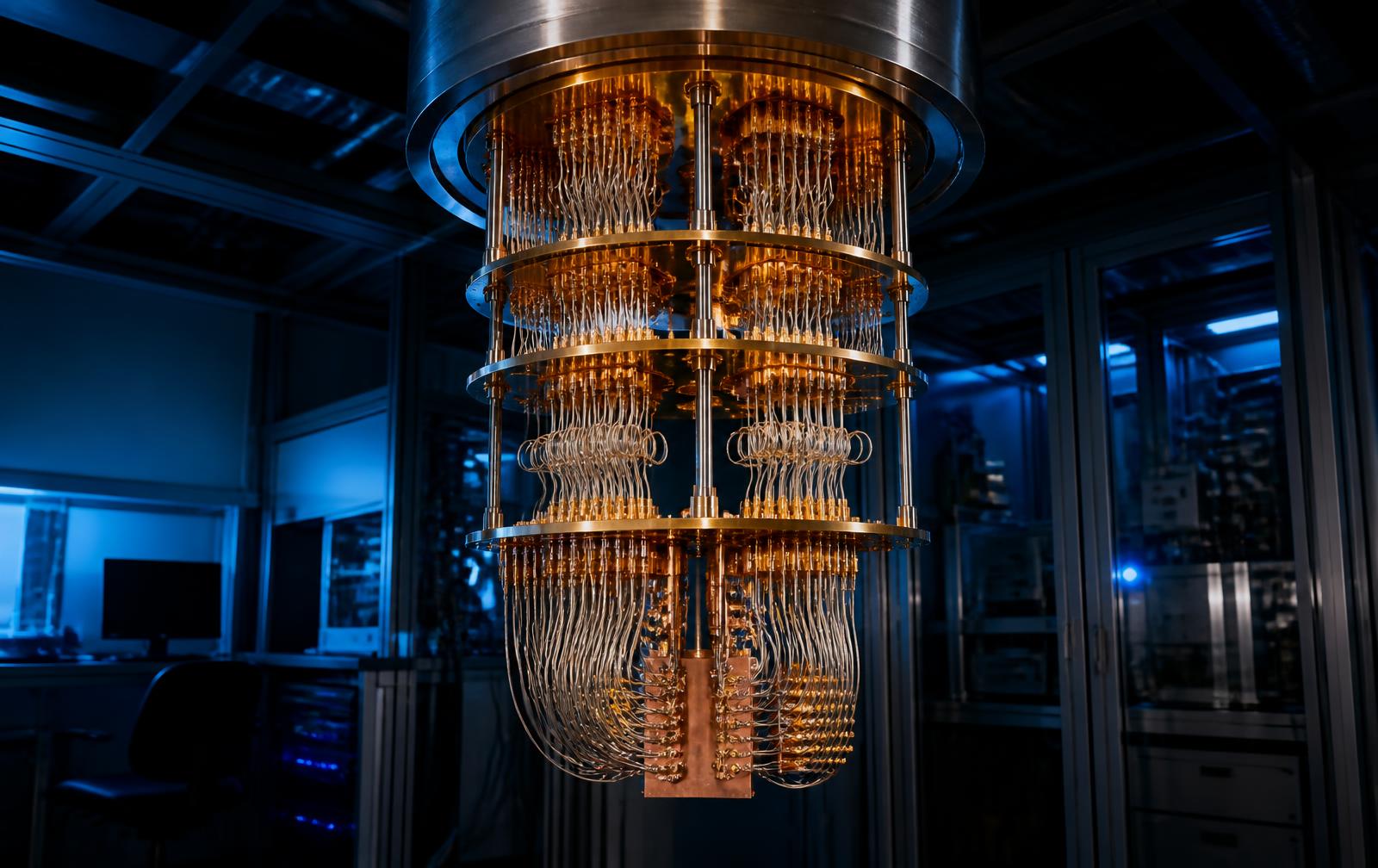
How Quantum Amplitude Amplification Raises the Odds of a Useful Answer
Quantum amplitude amplification is a general algorithmic technique that increases the probability of measuring desired outcomes, providing a quadratic reduction in the number of trials for certain search and estimation tasks.
By The Quantum Lab desk
Written in-house by the The Quantum Lab desk — an explainer, not a report of a news event.

- Amplitude amplification increases success probability through repeated quantum interference rather than by inspecting every candidate simultaneously.
- For an unstructured search among N possibilities, it requires on the order of the square root of N oracle uses.
- The advantage depends on efficient state preparation, a practical oracle and enough coherent operations to complete the amplification sequence.
A quantum algorithm often prepares a state in which only a small fraction of the measurement probability corresponds to useful answers. Repeating the entire algorithm until one of those answers appears can be expensive. Amplitude amplification raises that success probability before measurement by using controlled interference.
The procedure starts with a state-preparation operation and an oracle that can distinguish desired outcomes. The oracle marks those outcomes by changing their quantum phase, without directly revealing which outcomes they are. A second transformation then reflects the state in a way that shifts amplitude toward the marked subspace.
Each amplification round can be viewed as a rotation within a two-dimensional space defined by the desired and undesired components of the state. Repeating the round moves the state progressively closer to the desired component, making a successful measurement more likely. Too many rounds can rotate the state past the optimum, so the stopping point matters.
Grover’s search algorithm is the best-known instance of this method. Searching an unstructured set of N candidates classically requires up to order N oracle checks, while the quantum procedure uses order square root of N checks. This is a quadratic improvement, not an exponential one, and it does not eliminate the cost of implementing the oracle.
Amplitude amplification can also be applied when a larger algorithm already has some nonzero chance of success. Its practical value then depends on whether state preparation, phase marking and their inverse operations can be performed efficiently and coherently. Noise and gate overhead may outweigh the reduction in repeated trials on present-day hardware.
This story started as a thread in our Discord. Join the discussion with the researchers and engineers who work on it.
Related
Open-source compiler cuts logical-qubit overhead by a third
A new lattice-surgery scheduler squeezes routing overhead out of fault-tolerant circuits, and it ships under a permissive license.

A shared benchmark suite for logical qubits gets a first draft
Vendors publish incomparable numbers. A working group wants one protocol everyone can run.
Surface-code processor stays below threshold as it scales to 1,000 qubits
The logical error rate keeps falling as the code distance grows — the clearest sign yet that adding qubits now buys reliability instead of noise.