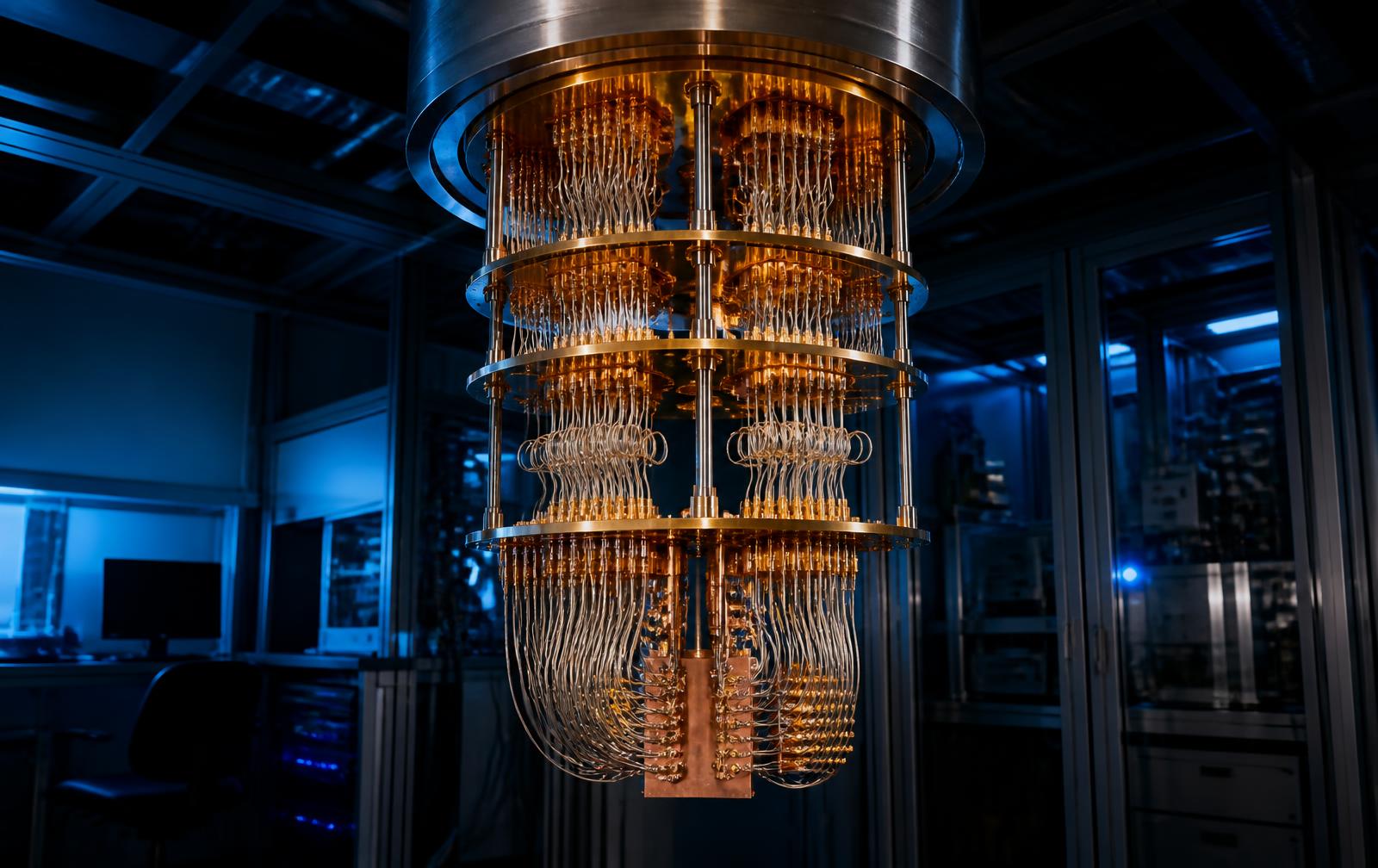
How Quantum Amplitude Amplification Boosts the Chance of a Useful Result
Amplitude amplification is a quantum algorithmic technique that increases the probability of measuring desired solutions, but its practical value depends on how efficiently a problem can be encoded and checked.
By The Quantum Lab desk
Written in-house by the The Quantum Lab desk — an explainer, not a report of a news event.

- Amplitude amplification rotates a quantum state toward a subspace containing desired solutions.
- Its quadratic query advantage applies to repeated uses of a suitable quantum checking procedure, not automatically to total runtime.
- Oracle construction, circuit depth and imperfect knowledge of the initial success probability can limit practical gains.
Many quantum algorithms produce a desired answer only with some probability. Repeating the entire computation can raise the chance of success, but ordinary repetition may require a number of trials inversely proportional to that probability. Amplitude amplification offers a quantum alternative that can reduce the required number of repetitions quadratically under suitable conditions.
The method begins with a quantum procedure that prepares a superposition containing both desired and undesired outcomes. A marking operation, often described as an oracle, changes the phase of states representing acceptable solutions without directly measuring them. A second reflection acts relative to the initial state, and the combination shifts amplitude toward the marked subspace through interference.
Geometrically, the algorithm can be viewed as a rotation in a two-dimensional space spanned by the desired and undesired components of the state. Each iteration rotates the state closer to the desired direction, increasing the probability that measurement returns an acceptable result. Grover's search algorithm is the best-known special case, where the initial state is typically a uniform superposition over candidate items.
The speedup is usually expressed in terms of oracle queries: if the initial success probability is p, classical repetition requires on the order of 1/p attempts, while amplitude amplification can require on the order of 1/√p iterations. This does not guarantee the same improvement in wall-clock time, because implementing the state preparation, oracle and reflections may be expensive. Data loading and verification costs must therefore be included when assessing an application.
Standard amplitude amplification also requires care in choosing how many iterations to perform. Rotating past the desired subspace can reduce the success probability again, and the optimal stopping point depends on information about the initial success probability. Variants such as amplitude estimation or adaptive schedules can address some of this uncertainty, but they add their own circuit and control requirements.
This story started as a thread in our Discord. Join the discussion with the researchers and engineers who work on it.
Related
Open-source compiler cuts logical-qubit overhead by a third
A new lattice-surgery scheduler squeezes routing overhead out of fault-tolerant circuits, and it ships under a permissive license.
A shared benchmark suite for logical qubits gets a first draft
Vendors publish incomparable numbers. A working group wants one protocol everyone can run.
Surface-code processor stays below threshold as it scales to 1,000 qubits
The logical error rate keeps falling as the code distance grows — the clearest sign yet that adding qubits now buys reliability instead of noise.