How Lattice Surgery Connects Logical Qubits in Surface Codes
Lattice surgery is a fault-tolerant technique that performs logical operations by temporarily merging and separating patches of error-corrected qubits.
By The Quantum Lab desk
Written in-house by the The Quantum Lab desk — an explainer, not a report of a news event.
- Lattice surgery manipulates encoded information through joint logical measurements rather than direct physical movement of qubits.
- Repeated stabilizer measurements make the merge-and-split process resilient to individual faults.
- Its practical cost depends on code distance, connectivity, measurement fidelity and the time required for repeated error-correction cycles.
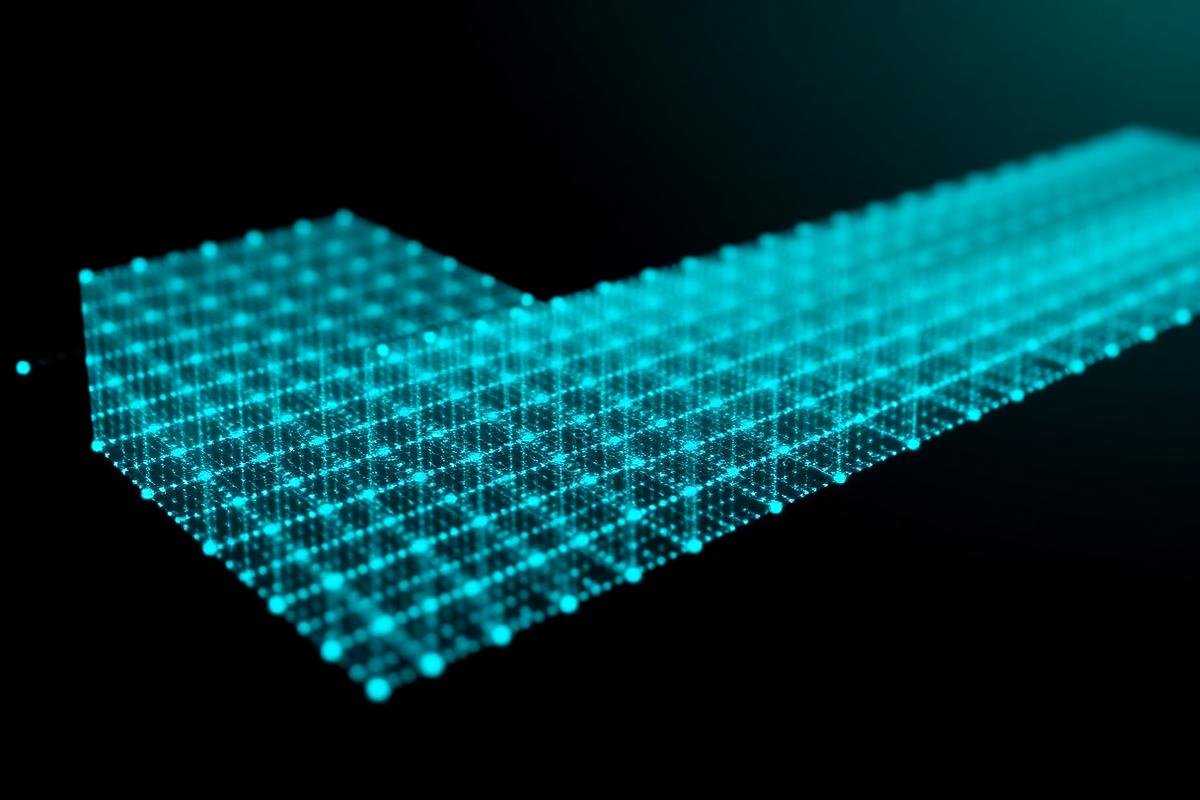
In a surface code, one logical qubit is encoded across a two-dimensional patch of many physical qubits. Local stabilizer measurements repeatedly reveal patterns associated with errors without directly measuring the protected logical state. The patch boundaries determine which extended chains of physical operations act as logical observables.
Lattice surgery creates interactions between logical qubits by changing which stabilizers are measured along neighboring patch boundaries. During a merge, new boundary-spanning checks measure a joint logical property, such as the parity of two logical operators. Splitting the patches again leaves separate logical qubits whose states reflect that measurement outcome.
The parity result cannot safely be inferred from a single round of measurements because physical measurements and gates can fail. A fault-tolerant implementation repeats the modified stabilizer pattern for multiple code cycles and decodes the resulting record across both space and time. The number of rounds generally scales with the code distance needed to suppress logical errors.
Sequences of joint measurements, auxiliary logical patches and classical feed-forward can implement operations such as logical CNOT gates. More general computations also require non-Clifford resources, commonly supplied through prepared magic states and magic-state distillation. Lattice surgery provides a structured way to route and consume those resources without requiring transversal gates between arbitrary code blocks.
The method trades hardware simplicity for substantial space-time overhead. Its local checks suit planar architectures with mostly nearest-neighbor couplings, but useful layouts still need room for ancillary patches, boundaries and routing corridors. Performance therefore depends not only on physical error rates, but also on decoder latency, leakage control, measurement quality and the scheduling of many simultaneous stabilizer cycles.
This story started as a thread in our Discord. Join the discussion with the researchers and engineers who work on it.
Related
Entanglement distributed across a live metropolitan fibre network
Not a dedicated dark-fibre link — the demonstration ran alongside ordinary classical traffic on deployed infrastructure.

Classical simulation closes in on another advantage claim
A tensor-network method reproduces sampling results that were argued to be out of classical reach.
Surface-code processor stays below threshold as it scales to 1,000 qubits
The logical error rate keeps falling as the code distance grows — the clearest sign yet that adding qubits now buys reliability instead of noise.