
How Dispersive Readout Measures a Superconducting Qubit
Superconducting qubits are commonly measured indirectly by detecting how their quantum state changes the response of a coupled microwave resonator.
By The Quantum Lab desk
Written in-house by the The Quantum Lab desk — an explainer, not a report of a news event.
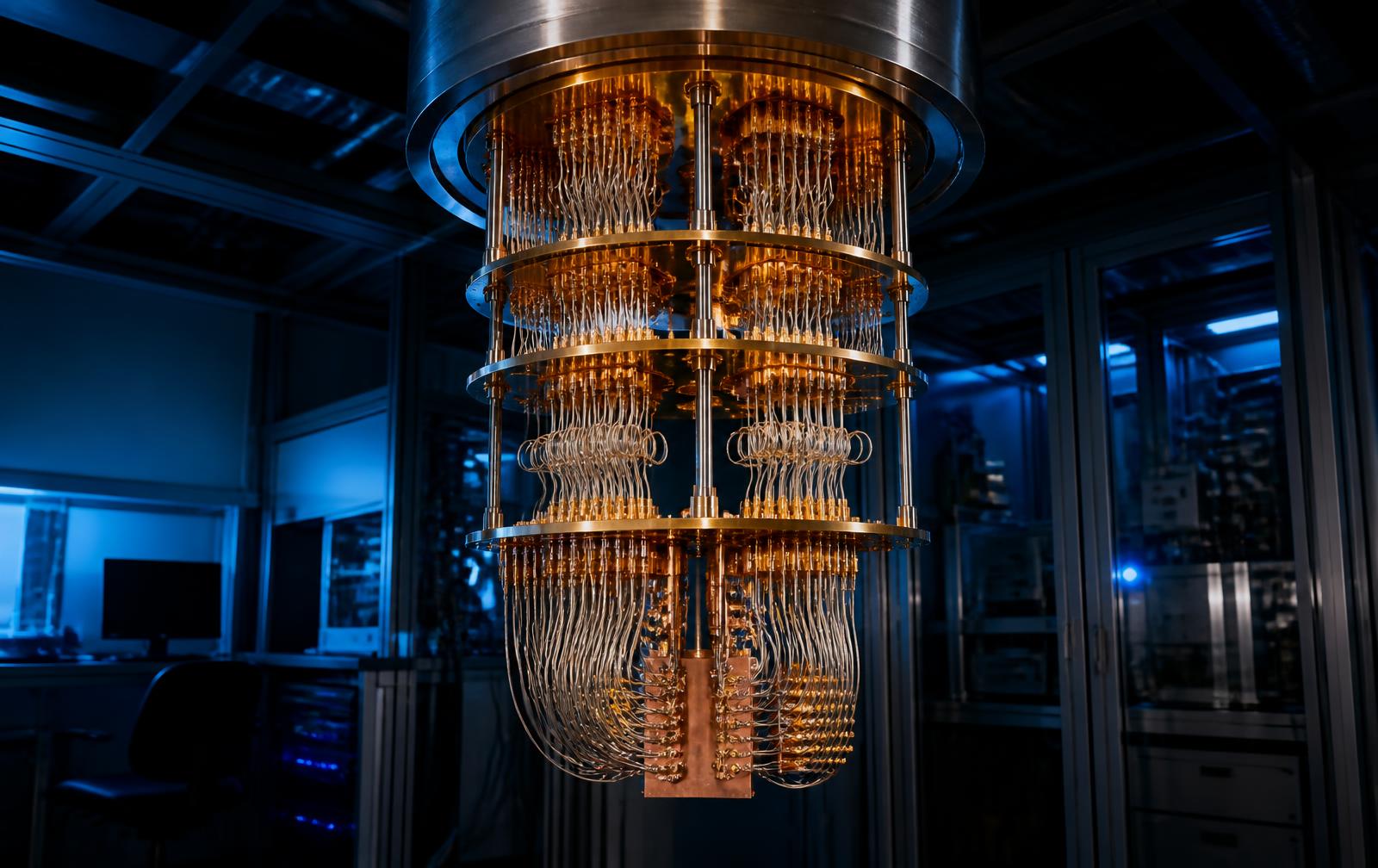
- Dispersive readout infers a qubit state from its effect on a microwave resonator rather than measuring the qubit directly.
- The measurement chain must amplify extremely weak signals while adding as little noise as possible.
- Readout accuracy depends on trade-offs among signal strength, measurement time, qubit disturbance and hardware complexity.
A superconducting qubit is often coupled to a microwave resonator whose natural frequency depends slightly on the qubit’s state. In the dispersive regime, the qubit and resonator are sufficiently detuned that they do not ordinarily exchange real excitations. Instead, their interaction produces a state-dependent shift in the resonator’s frequency.
To perform a measurement, control electronics send a microwave pulse into the resonator and record the returning signal. The signal’s phase and amplitude differ depending on whether the qubit is in its ground or excited state. Repeating the procedure produces clusters of measurement outcomes that can be classified as the classical results 0 or 1.
The returning microwave field is extremely weak, so it must pass through low-noise amplifiers before room-temperature electronics can digitize it. Quantum-limited parametric amplifiers are often placed at cryogenic temperatures near the processor to improve the signal-to-noise ratio. Later amplification stages add gain but cannot recover information already obscured by noise at the front of the chain.
Readout is not perfectly passive. A stronger or longer pulse can make the two states easier to distinguish, but excessive resonator population may disturb the qubit, drive transitions or violate assumptions behind the dispersive approximation. Engineers therefore optimize pulse shape, power and duration alongside resonator linewidth and amplifier performance.
Several resonators can be assigned different frequencies and connected to a shared transmission line, allowing frequency-multiplexed readout of multiple qubits. Scaling this approach requires careful management of bandwidth, frequency collisions, crosstalk and amplifier dynamic range. Readout performance must also be calibrated regularly because device parameters and the surrounding electronics can drift.
This story started as a thread in our Discord. Join the discussion with the researchers and engineers who work on it.
Related
Surface-code processor stays below threshold as it scales to 1,000 qubits
The logical error rate keeps falling as the code distance grows — the clearest sign yet that adding qubits now buys reliability instead of noise.
Trapped-ion shuttling record pushes two-qubit fidelity past 99.9%
Moving ions between zones used to cost coherence. A revised trap geometry makes transport nearly free.
Open-source compiler cuts logical-qubit overhead by a third
A new lattice-surgery scheduler squeezes routing overhead out of fault-tolerant circuits, and it ships under a permissive license.