
How Dispersive Readout Measures a Superconducting Qubit
Dispersive readout infers a superconducting qubit’s state by measuring how the qubit shifts the response of a coupled microwave resonator, avoiding direct energy exchange during the idealized measurement process.
By The Quantum Lab desk
Written in-house by the The Quantum Lab desk — an explainer, not a report of a news event.
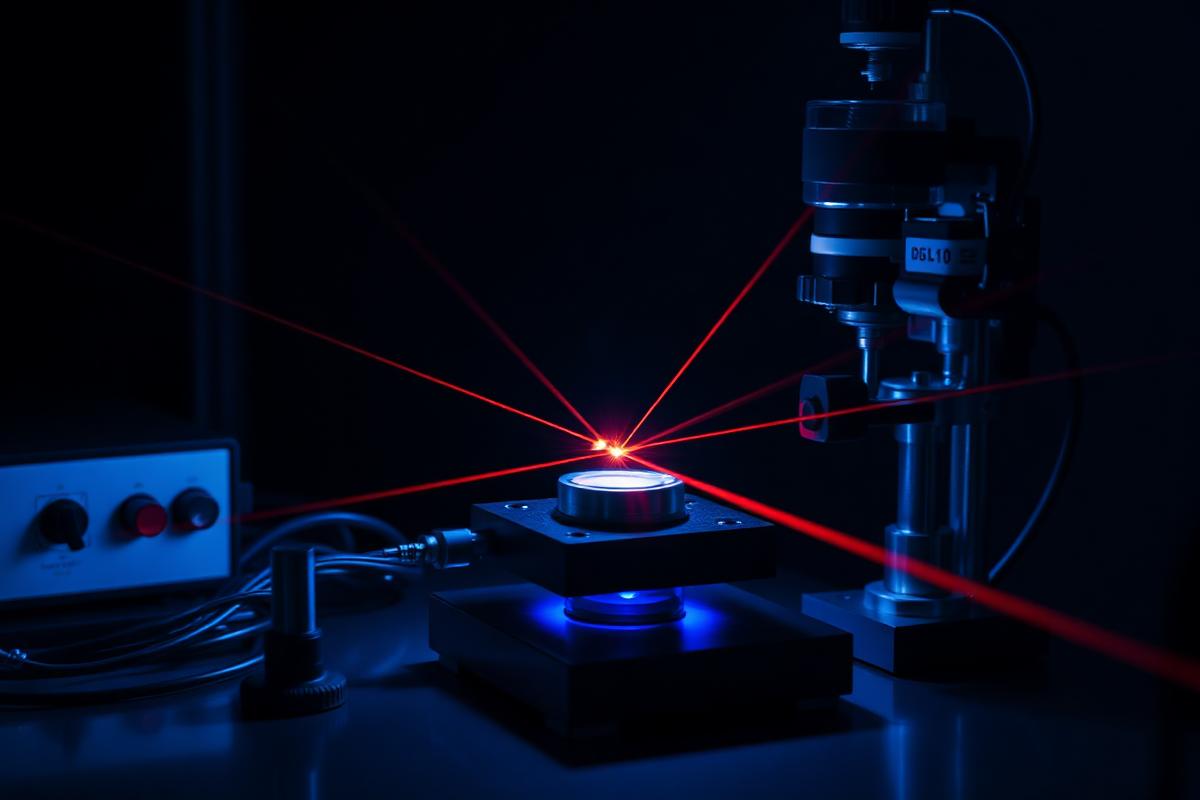
- A coupled resonator converts the qubit state into a measurable change in a microwave signal.
- Weak readout signals require low-noise amplification and statistical classification.
- Readout speed, accuracy and measurement-induced disturbance must be balanced in hardware design.
Superconducting qubits are commonly measured through a microwave resonator rather than by probing the qubit directly. The qubit and resonator are coupled but operated sufficiently far apart in frequency that they ideally do not exchange real excitations. In this dispersive regime, the qubit slightly changes the resonator’s effective frequency.
Engineers send a microwave pulse near the resonator’s frequency and observe the signal that returns or passes through. Depending on whether the qubit is in its ground or excited state, the outgoing pulse acquires a different phase and amplitude. These differences provide an indirect record of the qubit state.
The outgoing signal is extremely weak, so the measurement chain uses low-noise amplification, often beginning with a cryogenic parametric amplifier. Room-temperature electronics then demodulate the signal into two quadratures that can be represented as points in a plane. Repeated calibration measurements establish distributions associated with the qubit’s basis states, allowing a classifier to assign later results.
Readout is not perfectly passive. Photons placed in the resonator can shift the qubit frequency, cause dephasing or occasionally drive unwanted transitions, while qubit relaxation during the measurement can blur the distinction between states. Increasing pulse power or duration may improve signal separation, but only up to limits set by these effects and by the resonator and amplifier response.
Many processors connect several readout resonators to a shared transmission line, giving each resonator a different frequency so that multiple qubits can be measured together. This frequency-multiplexed approach reduces the number of external signal paths, but it complicates pulse design, filtering and calibration. Readout engineering therefore combines quantum-device physics with microwave design and statistical signal processing.
This story started as a thread in our Discord. Join the discussion with the researchers and engineers who work on it.
Related
Surface-code processor stays below threshold as it scales to 1,000 qubits
The logical error rate keeps falling as the code distance grows — the clearest sign yet that adding qubits now buys reliability instead of noise.
Trapped-ion shuttling record pushes two-qubit fidelity past 99.9%
Moving ions between zones used to cost coherence. A revised trap geometry makes transport nearly free.
Open-source compiler cuts logical-qubit overhead by a third
A new lattice-surgery scheduler squeezes routing overhead out of fault-tolerant circuits, and it ships under a permissive license.